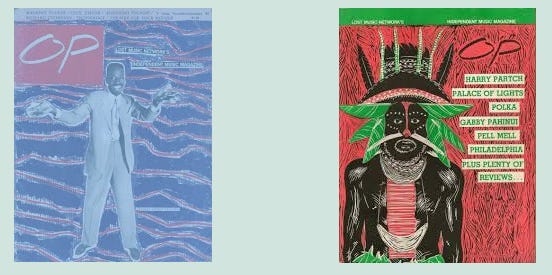
Smokin' OPs

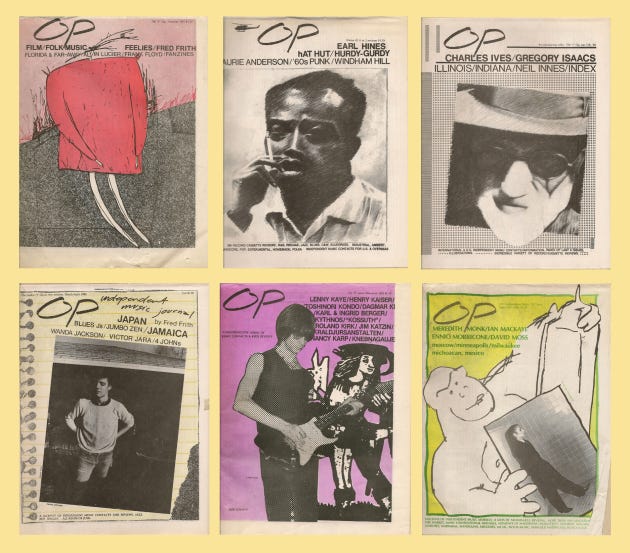
So I’m just about to stash away at the top of the closet the super-generous box of early ’80s OP magazines (the predecessor of the much more staid and seemingly market-researched Option) that Clifford Ocheltree gifted me through the mail last month (18 of the 26 alphabetically themed issues, in excellent condition), and I’m sitting on the toilet one last time skimming the reviews section of May/June 1984’s “W” issue with boogie-woogie pianist Katie Webster on the cover, when I come across a review of ESG’s Come Away album that seems pretty darn spot-on, and at the end of the review a byline I didn’t expect makes me do a doubletake: Chuck Eddy!
I would’ve been in the Army in Germany then, and until today, I had no recollection of writing anything for OP, ever. (I did publish one long Mexican rock feature in Option in the ’90s, after Spin sent me a kill fee for it. You can now find it in my third book.) My best guess is I sent the writeup in to the zine’s Olympia, WA address as one of the “unsolicited typed and double spaced” “under one half page” record reviews they requested every issue, then never noticed when it finally ran after their typesetter came back from vacation. So now do I have to go back and check the bylines in every one of those issues all over again, or what?
For posterity’s sake, here’s that ESG blurb: “ESG is a five-member (four sister, one male friend) New York band which plays the sparest funk of the Western hemisphere, a scary but rhythmic stripped-down-to-the-essentials sound which calls to mind such diverse forebears as dub reggae, Public Image Ltd., Ennio Morricone, recent Chic, field-recorded African pygmies, and Rough Trade ‘toy music’ bands like Essential Logic and the Raincoats. This is the congo-heavy combo’s first album; it repeats the best songs from the two 12″ EPs, and adds great new tunes like the eerie ‘Parking Lot Blues’ and the post-disco ‘My Love for You.’ If you haven’t heard ESG before, this is where to start; I suggest you start now.”
By the way, since I’ve probably offended some folks, don’t get me wrong — I did like Option! Just not as much. When I call it “staid and seemingly market-researched,” I just mean comparatively. OP was straight up weird, from deep-left-field cover artists to nursing-home record reviews on down. Every issue even had a cassette column!
Or to put it another way, Option later struck me as devoted to a fairly predetermined (though perhaps unusually wide) definition of what “alternative”is, with artists that’d actually sell magazines on the cover; i.e., it had actual business sense! (Which in my warped worldview counts as “market research” I guess.) OP was still hap-hazardly trying to figure all that stuff out, throwing darts against the “independent music” wall. A lot of that has to do with timing, obviously — before the New Music Seminar and college radio charts and indies as a major label farm system wrecked everything. Or something. (And I may well be underrating Option. It’s been a while!)
Longtime D.C.-area music freelancer (and onetime OP and Option contributor) Steve Kiviat alerted me to a brief 2011 interview with John Foster, founder of, as Kiviat put it, “the Lost Music Network (LMN) & then OP.” After OP reached its final Z issue in 1984, Foster recalls, “a group of folks from all over decided to start a new magazine based in L.A. From there, as I recall, it quickly split into two groups, and I provided my mailing list info and contacts to both of them. The only thing we said they couldn’t do was use LMN or OP. They had to have their own organizations/name.” One group started Option; the other a magazine called Sound Choice, which I barely remember, assuming I ever even saw it in the first place.
The issue pictured with that Foster interview is from the U edition (Upper Volta cover), one I both recently acquired and that definitely looked familiar to me from nearly four decades ago. R (Raincoats), S (Sun Ra) and T (Jamaaladeen Tacuma) also rang clear memory bells. My friend and future Swellsville editor Jack Thompson had a long letter to the editor in one of those that I still need to scan for him one of these days. (“In the case of [Simon] Frith I sometimes think the sociologist gets in the way of the music critic. When I finished his interesting if not completely satisfying book Sound Effects – Youth, Leisure and the Politics of Rock’n’Roll I was left only wishing that he took the music more personally.”) Not sure whether I had a four-issue subscription in late ’83, or found those installments in some cool German record store, or what. Had no idea until that batch arrived in the mail that OP‘s early issues, through N, were on tabloid-size newsprint — as I recall, just like New York Rocker, another now-obscure music periodical I absolutely adored in the early ’80s.
facebook, 31 July 2020