
Martians Throw a Dance
Blindfold Test #14

So about the German thing (seeing how five of the 25 randomly shuffled playlist selections below are from there, plus two more are Dutch which is almost Deutsche) — I lived in that nation’s pre-reunification West half from 1982 to 1985, years when homesickness joined with boosterism by X and the Blasters and Los Lobos and Greil Marcus to inspire my off-duty obsession with immersing myself in the roots of American music. So I regularly mail-ordered ancient country, blues, folk and rock’n’roll records from the Roundup and Down Home catalogs (which I’m seeing almost no evidence on the Internet of ever existing — I frequently sent away for more outré vinyl from the New Music Distribution Service catalog too, but that’s even more off-topic.)
Meanwhile, suddenly having expendable income as a company-grade Army officer and not yet having kids to spend it (or time) on, I made regular trips to record stores in Frankfurt, where I definitely spied out of the corner of my eye weird music I’d never heard of by German artists, but rarely bought it beyond the occasional Trio 45 or Einstürzende Neubauten 12-inch. It’s now clear there was clearly a lot going on in Central Europe back then, only a fraction of which I’ve ever seen documented even in passing by English-language critics, to this day.
Some of it might even have been a reaction to American soldiers like me fighting a Cold War that left nasty tank-tread tracks all over placid German farm fields. Hell, a crushworthy Berlin singer calling herself Nena actually scored a huge cross-continental hit single in 1984 about getting caught in the nuclear crossfire. It even got to #2 in the U.S.!
Since one thing I’ve tried to do with these blindfold tests is to weigh in on records that have otherwise fallen through media cracks, and since I continue to be curious about potentially intriguing stuff that I was only vaguely conscious of when it was still thriving, and since a good deal of electronic and especially so-called industrial music since seems inextricably indebted to what German record-store file shelf dividers at the time confusingly named Neu Deustche Welle, it shouldn’t come as too jarring a shock that so much Teutonia winds up in these mixes — More in this particular one than in any since the first couple, I believe.
Along with a pair of Australian indigenous rock numbers (another musical style Western critics remain oblivious to), another inclination you might pick up on below is an unusual quantity of bands who present themselves (via photos or at least names) as if they’d enjoy staging gang wars with each other. If this were The Warriors, which posse do you think would rumble their way to the top of the pile at the end of the subway line — Arson Garden, the Blackouts, the Brats, DMZ, Hank the Knife and the Jets, the Suicide Commandos, White Boy and the Average Rat Band, someone else entirely? No idea, but scores below should hint which ones I’d most likely root for, at least.
Poplar Mucilage is a reader-supported publication. To receive new posts and support my work, consider becoming a free or paid subscriber.
Grab Grab the Haddock, “For All We Know” (from Four More Songs By EP, 1985; Hertfordshire, UK, indie band, featuring former Marine Girls Jane and Alice Fox): Melancholic British-accented woman laments a relationship that didn’t work out. She could either be a ’60s pop singer — Petula Clark or Sandie Shaw or Lulu, say — or an ’80s new wave singer reviving their style. The light saxophone accompanying her voice has me leaning toward the former. Either way, she sings with an unmannered clarity that feels utterly believable. 7
Super Chick “Roach Killer“ (1980 single; Jamaican reggae deejay) A lady toaster flies to the U.S., taking out her passport and Visa and booking a flight on Air Jamaica while updating Peter Paul & Mary: “If you miss the plane I’m on, then you know that I have gone, Lord I’m 45,000 miles away from home”. Later she interpolates “This Ole Man, He Played One,” both references emerging effortlessly from the dense but mobile groove. There’s also something about a bush doctor — a Peter Tosh thing, right? She wears Roach Killer shoes, maybe or maybe not a brand but a vivid image anyway, though I hope she doesn’t have to stomp on any palmetto bugs (as they call them here in Texas) at the airport. Unless I’m confusing her with someone else, I’m pretty sure her name’s Super Chick, not to be confused with the later Christian girl band of the same name. I know no other songs by her, know nothing else at all, but she shows so much more presence here than the vast majority of male reggae deejays I’ve heard, and so much more humor (at least that I recognize as such) and specificity in her images — this in a subgenre that, in these blindfold tests at least, has way too often disappointed me as generic. I also enjoy her Mark E. Smithish tendency to affix-ah ah’s at the ends-ah of words-ah. 8.5
DMZ “Do Not Enter“ (from DMZ, 1978; Boston garage rock band featuring future Lyre Jeff Connolly): Fast, speed-drawled punk rockabilly; gotta be an early pub rock band. Count Bishops, Eddie and the Hot Rods, somebody like that whose allegiance to roots didn’t thwart their punch. “I’m gawwwn, to the break of dawn,” they say, but most of the words come too fast to make out, especially between all the hee-haws and hiccups. Voice and rhythm outdo anything in later rockabilly revivals, after punk stiffened everything up. The almost exaggerated high squeals might mean it’s from later, but I doubt it. 7.5
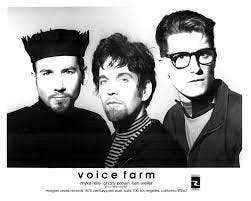
Voice Farm “Beatnik” (from The World We Live In, 1978, and Voice Farm, 1978; “electropunk, synthpop” “musical group and video collective based in San Francisco” [Wikipedia]): Electro dirge goth about.. losing hair? realizing it’s time to move to New York? everybody getting depressed sometimes (“that’s how it works”)?? Oh okay — beatniks!! Who apparently always stay up late with their deep dark secrets and dirty hairdos. At first I figured it for some dark artsy-fartsy Brits, but then I decided it’s more likely herky-jerking mid-American new wavers, Dow Jones & the Industrials or Carsickness or Get Smart! or somebody. Hence the robotic Devo voice. Singer keeps repeating something about “barooooshka”; is that some kind of fake Russian word? I feel like it was maybe also used once by herky-jerking mid-American new wavers Human Switchboard, whose best song was about a refrigerator door, and this song also mentions “re-frij-er-ay-tors”! Is he calling beatniks his role models? Surprised to hear the band stretch out at the end; ’til then, they don’t strike me as a stretch-out kinda guys. But hey, indie rock was still figuring itself out. 7.5
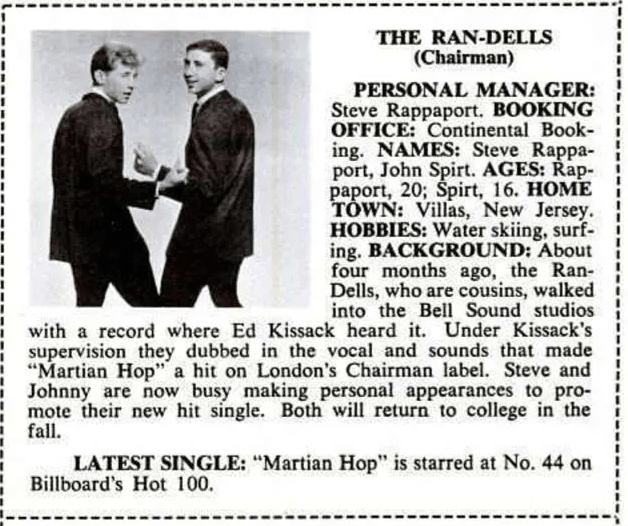
The Ran-Dells “The Martian Hop“ (1963 single; trio of Brandeis University first cousins from New Jersey who released only three 45s; according to The Encyclopedia of Science Fiction, “Steven Rappaport was studying electronic music at the time and here made the first use in a pop record of additive synthesis with sine-wave generators”): Eerie zoomy synthesizer start, “we have just discovered an important note from space, the Martians plan to throw a dance for the whole human race!” Wow man, count me in! Then it turns into over-the-top doo-wop, nutty like say “Papa-Oom-Mowo-Mow” by the Rivingtons, but with high squeaky nasal “muh muh mee mee mee”s instead of “pa pa pa pa pa pa pa oom ma ma ma mow”s. It’s clearly called the Martian Hop, and its beat is more a kind of jig than rock’n’roll, except in the sense that for a few seasons in the late ’50s or early ’60s anything could count as rock’n’roll, at least if it was the kind of novelty song teenagers would dig. To be honest, at first I thought this might be Brownsville Station, whose second-biggest hit was “Martian Boogie.” But then for some reason the deep useless recesses of my memory banks told me it might be a group called the Randells. I had no idea who the Randells could be, if in fact there ever were any Randells. 8
The Brats “Be a Man” (single, 1977, including on Criminal Guitar, 2002, Bratology: The Brats Collection, 2017, and sundry various-artist compilations; NYC glam rock band, featuring pre-debut-LP New York Doll Rick Rivets): Roars out of the gate full-speed-ahead like Creedence’s “Travelin’ Band,” or is it the New York Dolls? More fast rock’n’roll that actually rocks and rolls, boogie-woogie piano carrying it forward and the singer doing his best David Johansen imitation. “I’d be a man if I could, but I’m not yet a boy and that’s good.” If he’s not yet a boy, what is he? A girl, maybe? But the “yet” implies he’ll be a boy eventually. Or will he? “I just couldn’t be a man, I’ll n-n-never be a man.” Verses might not quite live up to the chorus, but this is still a real good song about the impossibility of meeting expectations as an adult and male in America. And why would you want to, anyway? 7.5
Fehlfarben “Angst” (from Monarchie Und Alltag, 1980; “Düsseldorf, Germany Neu Deustche Welle band): More herky-jerk scientist new wave, back when such stuff was still played on guitars. Oh wait, it’s Germans. They invented robot music, obviously. “Bitte bitte” means “please please” and there’s something about a “strasse,” aka street. No synths in the forefront, but mechanical anyway. And not heavy, but maybe angry — some Germans sure did yell their gutturals at you. 6.5
Debris’ “Leisurely Waiting“ (from Debris’, 1976, reissued as Static Disposal, 1999; “proto-punk/avant-garde band from Chickasaw, Oklahoma” [Punk Wiki]): Down-the-drain rusty-guitar-string racket introduces a theatrical Tim Curry-like whine seemingly bordering on camp. He picks up the paper and tears out the front page, something makes him sigh, short-term baubles and pleasures of the flesh and his vision are distorted by Satan’s own spit. Talk about your rocky horror! Blinded from right and wrong, he eats his brother because he craves his blood. (Why else?) His vocal cadence seems inspired by Bowie’s “Queen Bitch,” just like that one Killers song. This is way noisier though. The vocal parts are catchy enough, but guitars scritch and scratch all through, managing to form a kind of rhythm but turning especially clamorous and vehement for an extended bridge. 7
Carambolage “Roxan” (from Carambolage, 1980; all-female Fresenhegen, Germany new wave trio): Electronic industrial reggae, or a woman singing cabaret at a carnival? She seems in distress, understandable given how her mouth is apparently shrouded in aluminum foil. Is she saying “black fan”? And if so, why? She starts operaticizing in a foreign tongue — more German, I think — then she’s back to repeating “black fan” again and again. Spooky drums clink and clank and clatter, and she sure sounds ticked off — Maybe she should go on a date with the angry guy who just sang the previous German number, if their gender preferences allow it. Behind her, a coven of witches chant mystical spells while flying around with synthesizers on their broomsticks. Goblins start banging on trashcans, and at the end the singer kind of goes over the edge: “black faaaaaaaaaan….” 7
Andy Kim “Shoot ‘Em Up Baby” (single and on How’d We Ever Get This Way, 1968, and numerous later best-of sets; Montreal-born Lebanese-Canadian pop singer-songwriter who co-wrote the Archies’ “Sugar Sugar”): Sweet and gentle ’60s girl-I-love-you pop over a friendly drum clomp. He doesn’t doubt she loves him too but she’s so young, she’s just begun, so he worries she’ll eventually come to regret what she’s missed out on. “So shoot ’em up baby, get on out” — for some reason that part makes me wonder if it’s a ’70s pop rock band just trying to sound ’60s instead. He’d rather take the chance on losing her now than lose her years from now when he’ s more deeply invested in the relationship. If you love someone set them free, spread your wings and fly, but keep your powder dry. The chorus is all hook but still confuses me — who exactly is she shooting? 6.5
Fra Lippo Lippi “I Know” (from In Silence, 1981, Fra Lippo Lippi, 1986, and The Early Years, 2003; “Norwegian post-punk synthpop band from Nesodden” [discogs]): More ominous electronics, doing a surf-rock thing under a murmuring male opening up his mouth for the dentist and saying “aaaahhh ahh ahh.” It’s like they’re surfing the sea of tranquility — or at least maybe the Tasman Sea around New Zealand, or Lake Erie near Cleveland, given its pretty power jangle. 6.5
John Cooper Clarke “Night People” (single and on Zip Style Method, 1982, and later best-of LPs; “performance poet and comedian” [Wikipedia] from Lancashire, UK): Britisher talking in rhyme atop a jazzy piano and skibbidi-bobbidi-boo electrobeat about “night people, funky but neat,” hence referencing David Johansen’s “Funky But Chic” and maybe Lee Dorsey’s “Night People,” though the latter’s a stretch. John Cooper Clarke, obviously, chronicling “the right people on the wrong street,” though “the evil Mr. Cavindish” might be the wrong person on the right street instead. Once again, I can’t help but wonder whether Neil Tennant might’ve been listening. 6.5
The Blackouts “Everglades” (from Lost Soul’s Club EP, 1985, and History in Reverse, 2005; Seattle “punk/post-punk/hard rock” band [Wikipedia]): Spoken words over bongos, then deep deep Adrian Sherwood-style dub and a comparably banging vocal that immediately makes me think Mark Stewart in (or after) the Pop Group. Noise spurting at all angles, long stretched-out vowels, high-soaring yawps, gigantic and rambunctiously driving drums. “Killing the people that are comiiiiiiiing back,” is that what they just said? Not verse-chorus-verse, but not unstructured. “Intoooooooo the Ev-er-glay-ay-ay-ay-ayyyydes,” what’s that about? Reminds me a lot of the clankiest, sweatiest, swampiest parts of Public Image Ltd.’s Second Edition — “Careering,” I guess. Both sides of the river there is a bacteria. And turns out there’s even more John Lydon than Stewart in the squealing. Plus a chattering high-pitch coda, like a chant, chant, chant… 7.5

Geier Sturzflug “Bruttosozialprodukt“ (single, 1982, and on Heiße Zeiten…, 1983, and later best-of LPs; “Neue Deutsche Welle/ Deutschrock/ska/reggae/disco-Schlager” band from Bochun, West Germany): Handclapped German schlager verging on rock’n’roll (and not a parody thereof either), with what sound like Joe “King” Carrasco Tex-Mex organs and accordions and saxophones; i.e., rhythms that not coincidentally link back to oompahs and polkas. Can’t say the frontman has much vocal personality, and its lightness clearly comes from the cheese aisle, but it’s as energetic as you could ask. 7
Yothu Yindi “Mainstream” (single and on Homeland Movement, both 1989, Tribal Voice, 1992, and later career anthologies; “Australian alternative rock band, founded in 1986 from a merger of Darwin rock band Swamp Jockeys with a local Yolngu traditional music group” [discogs]): Immediately the sound reminds me of Midnight Oil, which almost definitely makes this an aboriginal Australian rock band, probably Coloured Stone or Yothu Yindi. Especially considering I’ve never seen the genre described anywhere, it’s amazing how specific and unmistakable its sound is, and not just because of that wobbly didgeridoo at the start. What I still haven’t figured out is whether Midnight Oil got their sound from indigenous bands, or vice versa. Singer has “six pretty gals” on his mind (one less than the Eagles in “Take it Easy”), but he’s also paying honor to fallen heroes and looking at reflections in the water he’s floating on. He’s crossing rivers and valleys, listening to the thunder and rain rage. As much as in any folk music, performers in this style are committed to the land, to terrain features and weather patterns. The title seems to be “Living in the Mainstream,” and with this music I doubt the main stream is just a metaphor. At one point the singer yells “come on!” and loud anthemic guitars start ringing, uplifting like in early U2. Eventually, a woman’s voice comes in, and she and the lead singer trade the line “we’re living together” back and forth, then a mantra maybe about children. 7
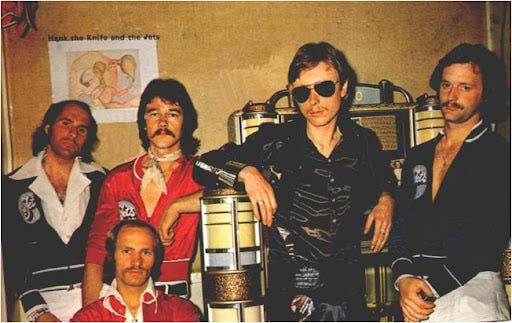
Hank the Knife and the Jets “Catherina Serenade” (single B-side and on Guitar King, both 1975, and later best-of LPs; Arnhem, Netherlands rock’n’roll band “leaning heavily on Duane Eddy’s style” [discogs]): “Stairway to Heaven” finger picking, folk from the dark dank European forests and moors and bogs. A string section too, but then it turns into a science fiction score, lutes in space. The melody intermittently also somehow mirrors “Born Free,” a song I’ve recognized since childhood and I’m pretty sure was about a lion. 6
Der Plan “Hey Baby Hop” (from Golden Cheapos Vol.1&2 EP and Japlan, both 1984, Fette Jahre, 1986, and various-artist collections such as Bureau B’s 2021 Eins Und Zwei Und Drei Und Vier; electronic Dusseldorf Neue Deutsche Welle band): New wave pop, or maybe electro, version of funk…and whoops, another German version as well. The keyboard is wonderfully sprightly and there doesn’t seem to be a main voice, first just men and women offering seemingly random syllables from multiple directions. Then a deep guttural proto-industrial guy, then high squeaky “do it! do it! yeah baby do it!”s, then lots of different people counting “eins zwei drei,” then Mr. Guttural again. But meanwhile it also keeps easing up into almost a nursery rhyme, and the voices get shuffled up, so the do-its and babies overlap the einses and zweis. Whoever made this was clearly having loads of fun. 7.5
Nicole “Ein Bißchen Frieden” (single and on Ein Bißchen Friedan, both 1982, and many subsequent best-of LPs; schlager singer from Saarbrücken, Germany who won 1982 Eurovision contest with this song): Commercial schmaltz pop of a probably ’80s vintage, but more… German, surprise surprise. A fraulein, or is it two frauleins, warbling a power ballad, halfway down the Autobahn from Abba to Dianne Warren. The tune feels at least as Mediterranean as Teutonic or Scandinavian. “Ein bisschen” — means “a little bit,” right? 5.5
June Brides “We Belong“ (single and on No Place Called Home EP, 1985, and For Better or Worse, 1995; London indie band): Repeated guitar riff reminds me of “Add It Up” by Violent Femmes (which I concluded decades ago is more or less “Smoke on the Water” sped up — in fact I realized it when my now going-on-33-year-old son Sherman was playing “Smoke” too fast on a piano as a kid), and so does the adenoidal mewl of a vocal (remind me the Femmes I mean.) At one point, generations ago, this might have been called “folk punk”; decades later, maybe “emo.” Which is to say, Jonathan Richman’s grandkids. Singer, who seems like a nice enough beta male, for some reason mentions his laundry list, causing me to wonder: why would anybody need to list their laundry, anyway? But okay, maybe this one is from New Zealand. If not from Creation Records in the UK. 6.5
Yothu Yindi “Baywara” (from Freedom, 1993, One Blood, 1998, and Healing Stone [The Best Of Yothu Yindi], 2012): A brief pipe organ note followed by silence, then a strong “maker of the land, maker of the soil, maker of the constitution.” (At first I thought soil was “song,” but I changed my mind.) A woman’s voice is soon joined by a man’s — menacing hippie music, with dogs bow-wowing in the back yard. But oh yeah, just remembered dogs are another characteristic particular to Aussie indigenous rock! I know no other genre so willing to incorporate actual barking, unless didgeridoos can imitate dingos. Which never occurred to me until right this second. And given my observations about the genre earlier, the land and soil shoutouts fit right in. There’s also city streets and shorelines, and ye olde bamboo or wooden trumpet mimicking wah wah effects, with some funk to it. A dance song, working in what I assume to be a native chant and hitting small internal climaxes and eventually a semi-psychedelic vocal bridge. 7
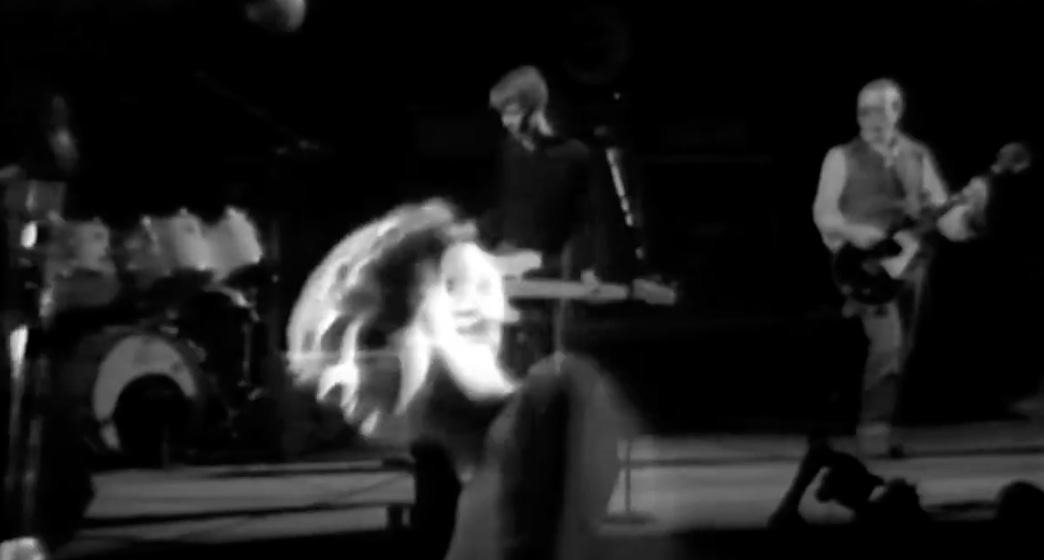
The Suicide Commandos “Attacking the Beat” (from Make a Record, 1978; Minneapolis’s first punk rock band): Punky poppy simple-drum-shuffled hard rock about a girl who drives them crazy ’cause she won’t sit down ’cause she moves in a way that melts into the beat. Straight-up-and-down fake punk by dudes who just learned how to pogo last week and haven’t even cut their hair yet. No swing to the music, but it bounces in its own catchy way, as does its subject, apparently: “She can d-d-d-d-d-d-d-d-d-d-dance!!” 6.5
Arson Garden “Metro“ (1991 single B-side; Bloomington, Indiana, alt-rock band): Brit-accented woman mapping out the Metro and its turnstiles. Her voice isn’t thin but it’s awfully quiet, and the jangle picks up between her verses by necessity since she apparently can’t sing when music’s playing because you can barely even hear her when it isn’t. Actually I’m not sure she’s British. Comely melody, either way. 6
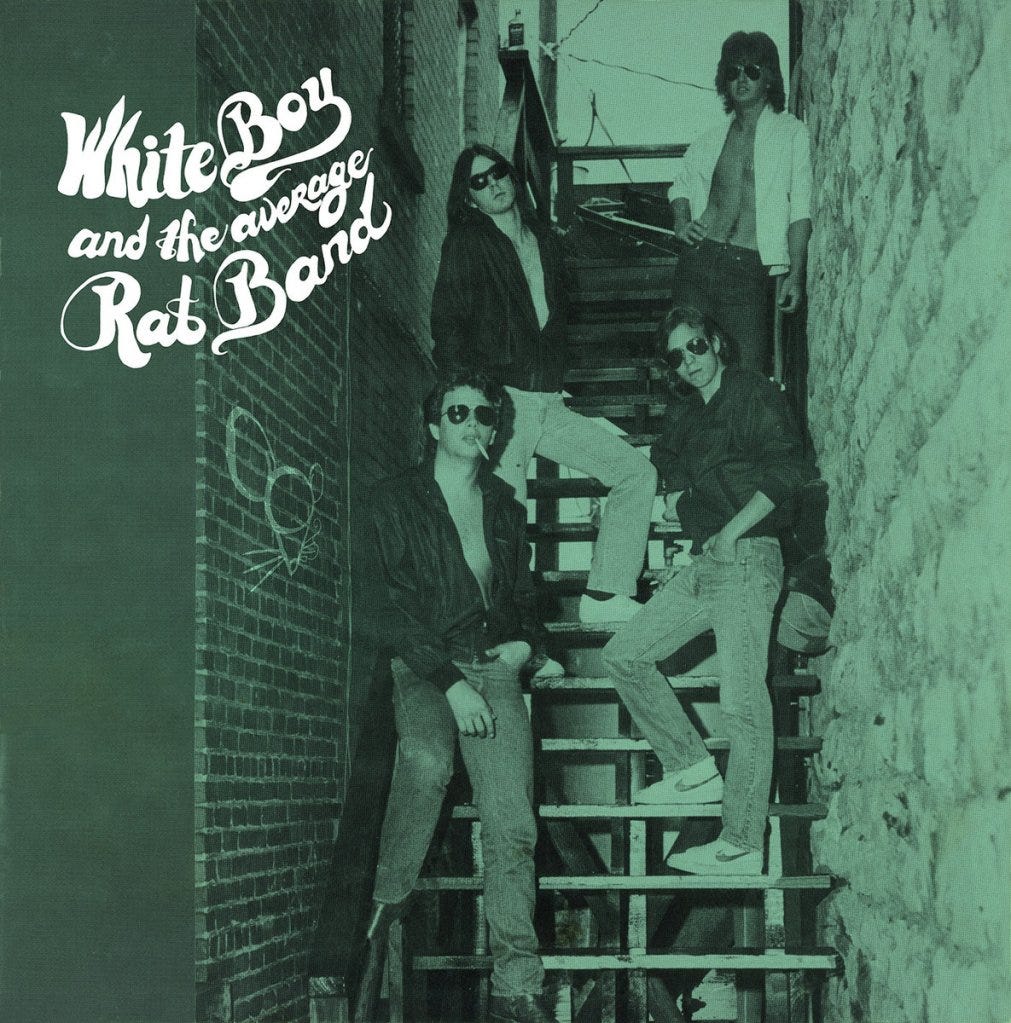
White Boy and the Average Rat Band “Oriental Doctors“ (from White Boy and the Average Rat Band, 1980; hard rock/heavy metal band from Toledo, Ohio via Richlands, Virginia): Guitars get gnarly and nearly metallic and take occasional wanky little solos over rolling drums while a howling macho tough guy burps his best Paul Rodgers blooze bellow and the rhythm section’s midtempo motion feels at least as forced if not more so. Lyrics seem to have something to do with a woman needing a doctor to get a prescription filled (potentially putting these bros alongside Van Halen, Kiss, Ted Nugent, Humble Pie, Robert Palmer, etc. in the classic doc rock category), and possibly also something about, er, breakfast in L.A.? The singing falls into a manhole now and then and has to excavate through a tunnel to re-emerge out the next one. The music grows heavier as the song progresses, and what you don’t expect is that, as the riffs get bigger, the sound turns brighter. Drums even pick up a little funk boogie steam. False ending, then a kind of rhythm jam — now they’re cooking, to the extent that you could almost dance to the sub-Nugent ’70s churn if you had to: Just what the doctor ordered for your kitten scratch fever? 6.5
The Solution “Free Inside“ (from Fully Interlocking, 1977, and later career retrospectives; Groningen, Netherlands, prog/jazz-rock band): Yacht-rockish, smooth-jazzish funk, carried by keyboard and bass. Tastefully tasty session-man rhythm and prettiness like the sun shining through the clouds, a useful palate cleanser after the previous track’s mud and muck. Could be a jam session for all I know. Not sure how skilled I am at evaluating this sort of thing, though I do think smooth jazz deserves more respect in general. And I would primarily tend to respect the funkier kind, which I expect would include this one. 6
Dick Damron “Hitch Hikin’“ (single, 1964, streamable — sometimes in mislabeled form — on 2012 Vintage Masters compilation Old Country Songs from Down on the Farm, Vol. 1; country singer, songwriter and guitar/banjo/fiddle/harmonica player from Alberta, Canada who “experimented with many musical styles.. including: ‘Outlaw’, Rockabilly, Honky Tonk, and Gospel” [Wikipedia]): A traveling man, hitchhiking his clippity-clop country hoedown all down the line, passing through towns looking for the best deals around. Standing on a dusty road, he sticks out his thumb and gets picked up by either a pickle truck or a “big ol’ truck,” hopefully the former. Nothing super special about it though I approve of hitchhike songs in general, and not just because it’s a rare English language word with a double “h.” 6

Eliminated for Reasons of Space, 11 July 2024
via facebook:
David Williams
I’m liking this post for the photo before I even read the piece!
Chuck Eddy
My plan exactly!
Phil Dellio
Love “The Martian Hop”–have it on a Dr. Demento compilation
Chuck Eddy
And here I thought you were gonna comment on Andy Kim!
Phil Dellio
Okay–no surprise, “Shoot ‘Em Up Baby” is an easy 10.0 for me, ditto “How’d We Ever Get This Way” and “Rainbow Ride.” Didn’t know he was Lebanese. He was still out there playing with Broken Social Scene as of a few years ago.
Chuck Eddy
Outside of “Rock Me Gently” (and “Sugar Sugar” if it counts), I don’t remember hearing any of his songs before this year. I gather his other singles were much bigger in Canada.
Brad Luen
re: Aboriginal rock: my (not 100% certain) impression is:
– Westernized Aboriginal music was traditionally pretty countryish
– Midnight Oil were the biggest band in Australia by 1983
– every pub band in Oz started sounding like Midnight Oil, incl. the one that became about half of Yothu Yindi
– Midnight Oil tours with numerous indigenous bands (incl. Yothu Yindi); this has some effect on their sound (though it’s mostly temporary) and a huge effect on their subject matter
I don’t really have a sense of the breadth of Australian indigenous rock though—almost everything that’s filtered through to me is in some way Yothu Yindi-related, and even geographically that’s only a tiny slice of the continent.
Chuck Eddy
What I’ve heard of Coloured Stone, I like even more than Yothu Yindi. And I’ve seen a couple various-artist compilations on streaming sites. Maybe I should look around for a history of the stuff; must be one out there somewhere. And the country influence doesn’t surprise me, given the amount of country that still comes out of Australia’s wild frontier otherwise.
Clifford Ocheltree
Geoffrey Gurrumul Yunupingu. This came out about 15 ago. Won’t even pretend to describe his work but a damn fine album none the less. Mentioned it late (?) last year..
Chuck Eddy
I tried with the Yunupingu album, sadly to no avail. Too amorphous or folkloric for me or something. But there’s also King Stingray, who made one of my favorite singles of 2022 (which technically came out a couple years before then.)
Clifford Ocheltree
A friend took me to see him in New Zealand about 6 months or so after that album was released. Residual effects of an excellent show? Who knows. I never really cottoned to any of his other albums.
Steve Pick
The Debris and Carambolage blurbs are brilliant and hilarious. They stand out among a bunch of really good blurbs. I love how hard you work to describe things while keeping us laughing.