Home With the Armadillo
After 16 years in Texas, eye-witness proof they're very much alive

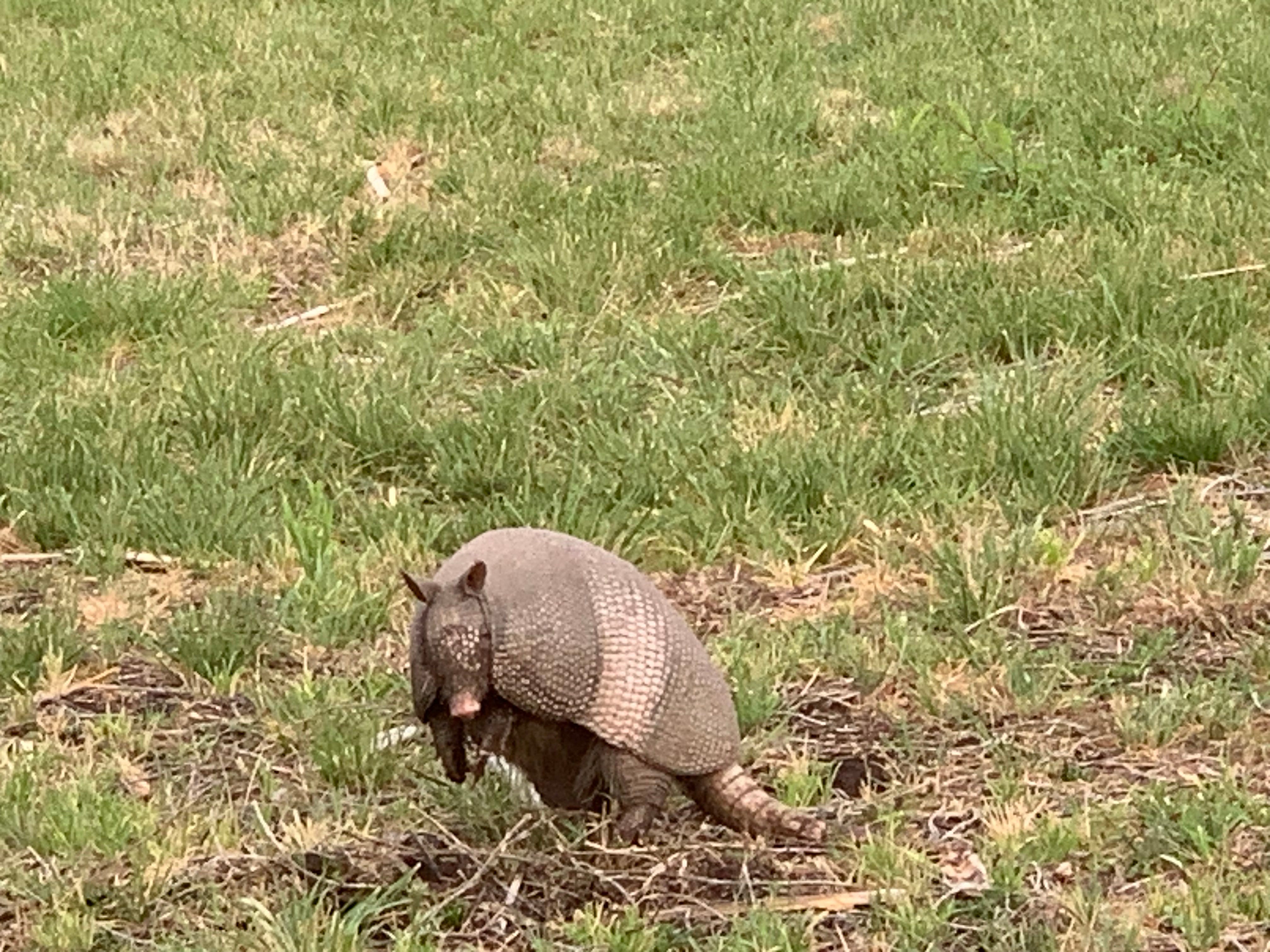
“I would have said for a long time, I did say for a long time, that armadillos are born dead. I had no evidence of any other point on their life cycle, imagining them a sort of wildflower growing along certain depressing stretches of highway, not so much blooming as from inception already gone to seed. Like the Vegetable Lamb of Tartary, a creature sprouted from a plant, tethered by its umbilical stem and grazing — only even less likely. I have made concerted efforts to spot the triangular divots of their snuffling in the dirt, have searched very deliberately for their traces and breadcrumbs, and still I would have believed they were a hoax. Until one night in the in the new neighborhood. One and then two. Two and then four…”
— A. Kendra Greene, No Less Strange or Wonderful: Essays in Curiosity (2025)
Same here! Well, not exactly, but close. I moved to Austin, Texas — the first place I have ever lived known to house native armadillos — in 2009; rented a duplex in North Central Austin until 2015, then got a house in the southernmost tip of town. And though it wasn’t unusual to see a road-killed specimen while driving, or occasionally one that had succumbed to a vehicle or carnivore or weather conditions as I strolled through the greenbelt woods or along a roadside ditch, in my first 16 years here I never once witnessed a live one. Several years back, my wife said she caught a glimpse of one near someone’s house as she jogged through the neighborhood; my daughter, now almost 18 but then significantly younger, managed to get a photo of one while attending the Sherwood Forest Renaissance summer camp. But not me — which given the extent and energy to which I spend time hiking woodland trails, did not seem fair.
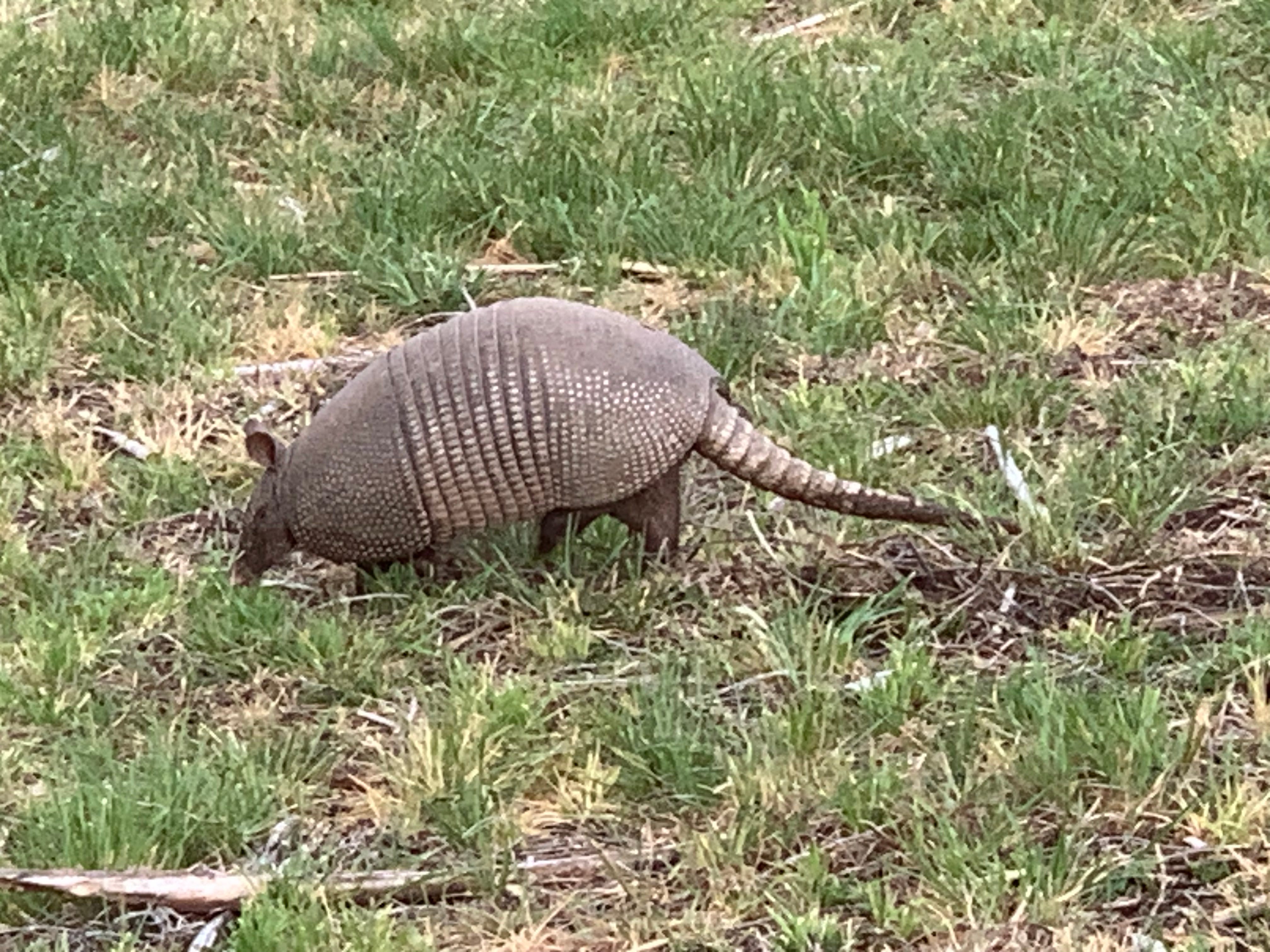
Especially since, around these parts, these mammals are iconic. My spouse Lalena is a Houston native, and one of her favorite Texas anthems is Jerry Jeff Walker’s “London Homesick Blues” : “I wanna go home with the armadillo, good country music from Amarillo and Abeline….” On February 2 in Texas, “Armadillo Day” (starring “Bee Cave Bob”) subs for Groundhog Day. Our weekly curbside compost pickups result in a substance called “dillo dirt.” And not only is a music venue called the Armadillo Den walking distance from our house, an even closer Americana roadhouse honky-tonk, Sam’s Town Point, displays a painted mural of an armadillo near its front entrance.
In 2026, though, I finally saw the genuine critter. On January 6, around 7:30 am, 15 minutes after sunrise and just after dropping Annika off at her bus stop to start her final high school semester, I noticed one scrambling quickly back into the treeline at Mary Moore Searight Park — for mere seconds, though; not long enough to pull out my phone and take a picture. But then on February 18, I started seeing one regularly, barely a three-minute walk from home — as a matter of fact, in a field off the street abutting Sam’s Town Point’s rear entrance. So I started taking pictures, even videos.
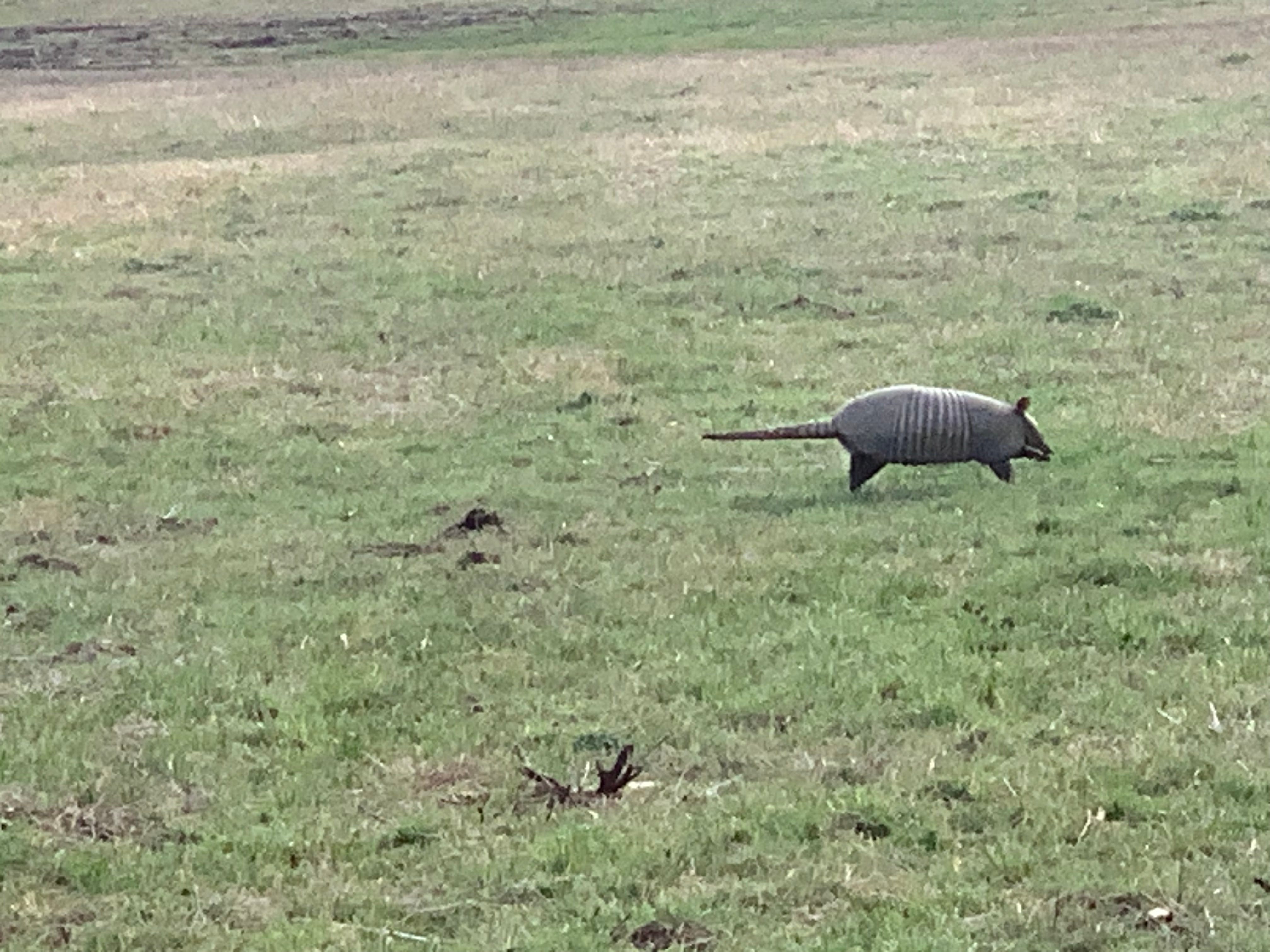
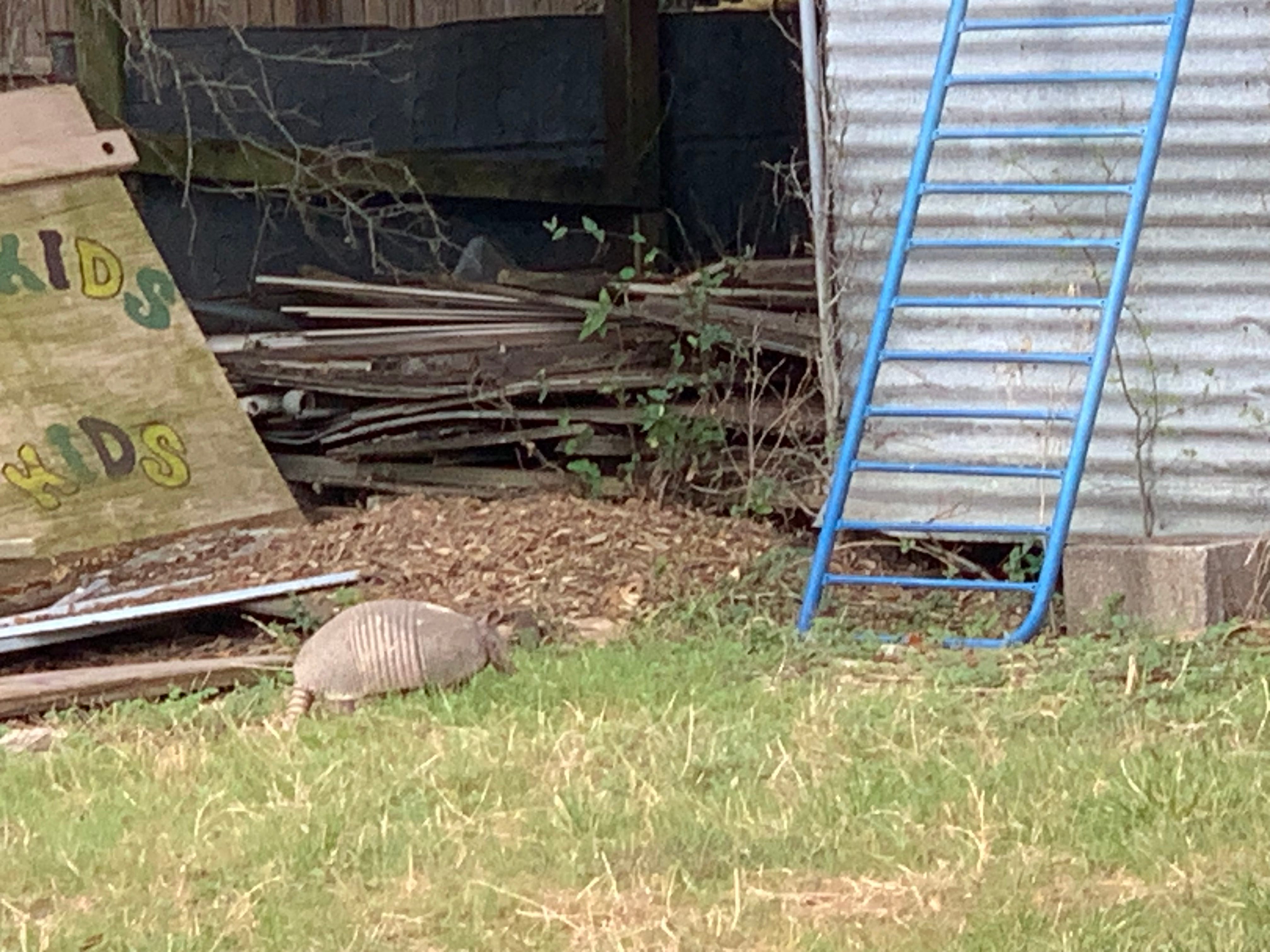
The trick, at least early this spring (mid-February often counts as “spring” in Austin), was to show up in the vacant field off Oak Valley Road just as dawn was breaking. The animal caught me by surprise at first, then I started to expect it — rooting in the ground I assume for insects and other vittles, occasionally standing up on its hind legs (which I didn’t know was possible), trotting back under the boat trailer and rundown storage shack where it seems to reside. My Boston terrier Cisco, who I generally tended to be walking at the time, would usually start whimpering, either because he wanted to try to play with it or try to eat it, I’m not sure which. (You can hear him in several of these videos.) At first this would scare the little ‘dillo away, but eventually it seemed to grow to trust us, thus enabling more photos and longer videos. Which I would send to my grown kids and my seven-year-old granddaughter Colette, who named it “Xylophone,” presumably for its segmented exoskeleton — even though, in retrospect, I wonder whether it technically more resembles an accordion.
One Saturday I saw a coyote at the other end of the field and woods, just 10 minutes after I saw the armadillo. After I texted out pictures of both, a clearly alarmed Colette pointed out, “Oh no, that’s its predator!” I’m not sure whether predator and prey ever performed their respective food-chain roles; it’s been a few weeks now since I saw Xylophone, but then again I’ve had a lot going on (shingles, prostatectomy, a trip to Michigan and Ohio), and meanwhile as mornings have brightened earlier, I haven’t been as good about getting out to the field on time. Hope Xylophone is still out there.
I should I guess point out that the armadillos we see around here are the nine-banded species (Dasypus novemcinctus.) Supposedly they can jump up three or four feet vertically into the air, which sounds startling but makes me think of guinea pigs “popcorning” and is something I would love to see. Supposedly they can also carry and transmit leprosy (Mycobacterium leprae), which sounds frighteningly biblical and is not something I would like to see — and, being somewhat sane, knowing it is more than enough to ensure I keep my distance. Also, contrary to myth, they cannot roll up into a ball. And according to Armadillo Online, “during the Depression, armadillos were often eaten by hungry people. They were called ‘Hoover hogs’ by people angry with then-President Herbert Hoover’s broken promise of a chicken in every pot. The meat is said to taste like fine-grained, high-quality pork.” (How’s that worse than chicken?)
When I was kid I remember armadillos being taxonomised as “edentates” along with anteaters and sloths, due to their dearth of teeth; plus they all come from the Western hemisphere. Apparently Edentata once also used to include pangolins and aardvarks, but by my time those two Old World mammals had each been awarded their own order. A 19th Century Webster’s Unabridged my family had inherited still used Carl Linnaeus’s 18th Century term for the order, which was “Bruta,” translated into English as the rather insulting “Brutes.” (The book was a gigantic leather-bound doorstop of a thing; though I was the sibling most obsessed with it when we were young, somehow my older brother wound up with it, which I have always resented.) Sometime in my lifetime Edentata was reclassified into the “superorder” Xenartha, divided into the orders Cingulata (armadillos) and Pilosa (sloths and anteaters.)
My reliable 800-page 1893 copy of Wood’s Natural History: Mammalia goes a different route, putting “the Manis, the Armadillo, the Ant-eater and the Platypus, or Duck-bill” in a “small but important family” callded Dasypidæ. “Manis” is what they then called pangolins, whose “scale-armour” is contrasted with armadillos’ “plate-armour.” And I like how they identify so many species by what I suspect are indigenous names.
Armadillo varieties included in Wood’s: (1) “The common ARMADILLO, or POYOU…about twenty inches in total length” and “very common in Paraguay,” which eats everything from tubers to worms to small reptiles to wild cattle offal, since it is “not at all particular in taste, and devours the half-putrid remains with great eagerness, becoming quite fat upon the revolting diet”; (2) The “APARA, or MATACO, which is often found on the Pampas,” protected by three armour bands and horny plates, and “When attacked it can draw itself into the perfect ball, which is impervious to the teeth of predaceous animals, for it is too large to be taken into the mouth and cracked; (3) “The PEBA, or TATOUHOU…a native of Guinea, Brazil and Paraguay…larger than either of the preceding species; (4) The little PICHEY ARMADILLO…only fourteen inches in length” and “a very active and rapid burrower, sinking below the ground with such celerity, that if a man on horseback sees a pichey scrambling over the ground, and wishes to secure it, he can hardly leap from his steed and stoop to take it up, before it has burrowed out of his reach”; (5) The TATOUAY, “mostly remarkable for the undefended state of its tail, which is devoid of the bony rings that encircle the same member in the other Armadillos”; (6) “The TATOU, or GIANT ARMADILLO,” of Brazil and Surinam, which “creature measures more than four feet six inches in length,” including a 17-inch-long, 10-inch-circumference-at-its-base tail “covered with regularly graduating horny rings, and when dried and hollowed, it is used as a trumpet by the Botocudos”; and finally (7), “nearly related to the armadillos is the remarkable little animal called the PICHICIAGO, a native of Chili [sic], which looks like a mixture of the mole and the armadillo.” (Compare biologists’ current list of more or less 20 species, a tally they add to and subtract from apparently at whim.)
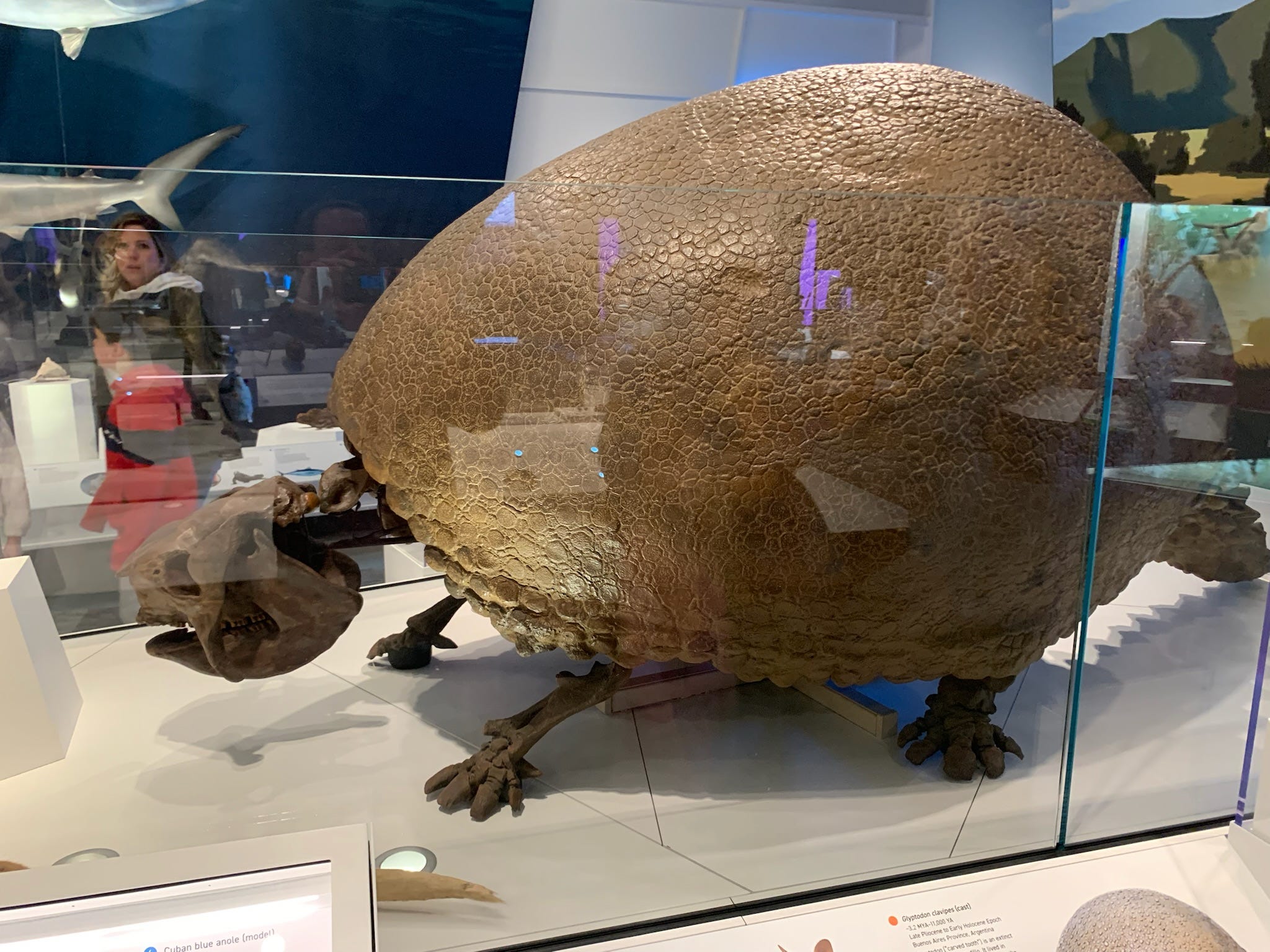
The book doesn’t list Glyptodon! Packing almost 900 pounds of weight into almost 7 feet of length, the prehistoric armadillo ancestor was identified in 1839, but had been extinct for about 11,000 years. So presumably J.G. Wood, M.A. F.L.S. was referring to a still extant species in his most entertaining armadillo story: “A friend of ours, who formerly resided in South America, had a pet Armadillo in his bed-chamber, where it generally remained quiet during the day, but in the dark hours was active and playful. One night after he had gone to bed, the Armadillo began dragging about the chairs and some boxes that were placed round the room, and continued so busily engaged at this occupation that our friend could not sleep. He at length arose and struck a light when, to his surprise, he found that boxes which he had supposed too heavy for such an animal to stir, had been moved and placed together, so as to form a sort of den or hiding-place in a corner, into which the animal retreated with great apparent satisfaction, and from whence it could only be drawn out after a hard struggle, and the retreat of some severe strokes from its claws.” Xylophone, meet your new role model!