
Feels a Bit Stuffy
Blindfold Test #12

This may hold the distinction of being the most “mid” batch of blind items yet, as the kids might say. Well, I’m not sure they’d say “batch,” but you get the idea — No grades above 7.5. or below 5, and seven ranked at either 5 or 5.5. Still, I’ll try my best not to make it boring.
With the oldest song here from relatively not-too-long-ago 1965 (a few previous blindfold tests have included songs from the 1920s and ’30s), it’s probably also the most ’60s-oriented list yet — six songs from that decade, three more songs that initially tricked me into thinking they might be. Plus a few that just barely missed the Dec. 31, 1969 deadline — one from 1970, two recorded in 1971, one from 1972.
As I mention below, 1971’s “Do the Oz” is included in the discography appendix in the back of Greil Marcus’s desert island record book Stranded. But so are late ’60s albums featuring songs considered herein by Wilbert Harrison (“the sort of music folklorists record on street corners, but somehow, Harrison got a hit out of it”) and the Youngbloods (“named for a Coasters song, they played quick and tight New York folk rock.”) Neither song impressed me much, but I can definitely still vouch for at least one other track on each record.
(Oops, just remembered Big Youth’s Screaming Target is also in that appendix, with a description I’ve always loved: “Addled Jamaican stays up all night raving about Clint Eastwood in Dirty Harry.” I liked his song okay, and generally like him more, even if I don’t catch all the cop movie references; shame on me for not recognizing him here.)
Also, this installment’s band called the Now is not the same as the band called Now in Blindfold Test #4. The Caroliner Rainbow cut is the first selection in any blindfold test (that is, out of 12 x 25 = 300 songs) that I was unable to find on youtube. And finally, more than half of the songs below (13 out of 25) are by British people, including — yikes — a few rather “whimsical” ones. Not generally my cup of tea time, but you never know, right? It helps to keep an open mind in such instances.
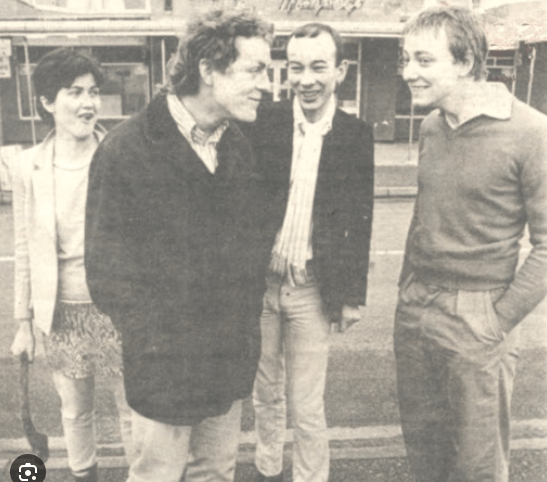
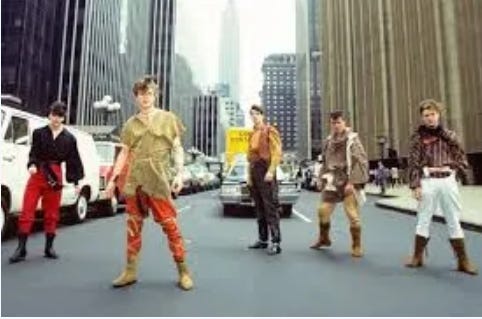
PragVEC “Wolf“ (from Bits EP, 1978, pragVEC EP, 1979; London post-punk band): High-shrieking woman-fronted probably-post punk with gargling out of Essential Logic and other wacky oral vibrations out of Kleenex (so, circa 1979 or ’80), whiney and cranky in a funny way. Also stuff about disappearing that itself disappears into the muffle. 7
The McCoys “Don’t Worry Mother, Your Son’s Heart is Pure“ (1966 single, included on Hang On Sloopy: The Best of the McCoys, 1995; Union City, Indiana rock band fronted by guitarist Rick Derringer): A studio audience laughing at somebody claiming to be Ed McMahon (how early was he was on The Tonight Show, or was he famous before?) then raga guitar, like Kaleidoscope I figured at first, then decided more “Paint it Black.” His “dear old mother” told him “watch out for city women, they’ll bring you down my son, they’ll take you to the gutter.” Sounds late ’60s, though I bet that’s on purpose — His voice seems too “regular” for the ’60s, there’s a blankness to his talking. Why settle for that, when good singers were everywhere back then? Eerie funeral intonations and gong sounds, probably a crash cymbal over and over. “Lied about the women, the gamblin’ too, there’s fun in the big city.” Backup vocals tell Ma not to worry. Too indie-rock self-conscious somehow, unless I’m just reading that into it. 6.5
Malaria! “You You“ (from Beat the Distance EP, 1985 and on Compiled, 1991; all-female “experimental electronic band from West Berlin” [Wikipedia]): Dancy opening makes me think “The Glamorous Life” by Sheila E., if maybe too repetitive about it, but then the singer starts moaning sepulchrally and it’s clearly goth instead. “How could I ever tell you that I was des-per-ate?” The beats turn out to be considerably more stiff than I initially expected. A sort of seven-note bell-ringing hook repeats again and again, seemingly stuck in a very small space, like say a coffin. Picks up energy, but takes too long. 6
Millie “De Hoy En Adelante“ (from Amar Es Un Juego, 1999, and later hit collections; “Puerto Rican pop singer and actress” [discogs]): Piano schlock, melody initially reminiscent of “Something in Red” by Lorrie Morgan ….But no, it’s a Selena-style Spanish ballad. Lovely sure, but so what? She gets wordy in the sense of smashing a lot of words into a measure, and I guess her increasing volume makes it a power ballad, but with nothing I hear to distinguish it from a thousand similar ballads. Would immersing myself in its possible sheer gorgeousness keep me from feeling so bored? Hard to say. Plenty of delicate filigrees to the vocals, as the genre (regional Mexican?) no doubt requires. And the final notes do exhibit a ’50s slow-dance tinge, so there’s that. 5.5
Big Youth “One of These Fine Days” (from Screaming Target, 1973, and later best-of sets; deejay/toaster from Kingston, Jamaica): Hard dancehall reggae about turning tables, possibly a popular dancehall topic judging from a previous blindfold test selection by Dennis Alcapone. Except this toastmaster might be less literal about it. He also might be redundant, if he did indeed just say “as long as you try, then you can make it if you try,” then string a whole bunch of “never”s after each other. A second incidental voice occasionally peaks around the corner to patois his two cents. What is it about dancehall toasters and the phrase “as I would say”? Of course they’d say it, because they are saying it! So kinda goes without saying, wouldn’t you say? Wouldn’t they? A Jamaicanism no doubt. This fellow’s crooning skills are equal to his toasting skills, though, so we’ll let it pass. 6.5
Elastic Oz Band “Do the Oz” (1971 single B-side by Plastic Ono Band under an different name): A loud harsh voice giving hokey pokey instructions: “Do the Oz baby, shake it all about.” This must be that (obscure, I gather) John Lennon B-side Greil Marcus lists in the back of Stranded. Squeaking, coughing, rhythmic croaking, throat clearing. Is the person suggesting dance steps Lennon? Can’t promise I’d necessarily recognize his voice in all possible circumstances. This is very silly, either way — basically a Dr. Demento novelty. And I’m pretty sure that’s Yoko chattering on there too. Definitely one of the funniest (at least intentionally) records I’ve ever heard either of them on. Guys at the end chant “do it, do it,” forecasting the Pink Fairies. Oh wait, aren’t they called the Elastic Oz Band? Not sure I know who that is. 7.5
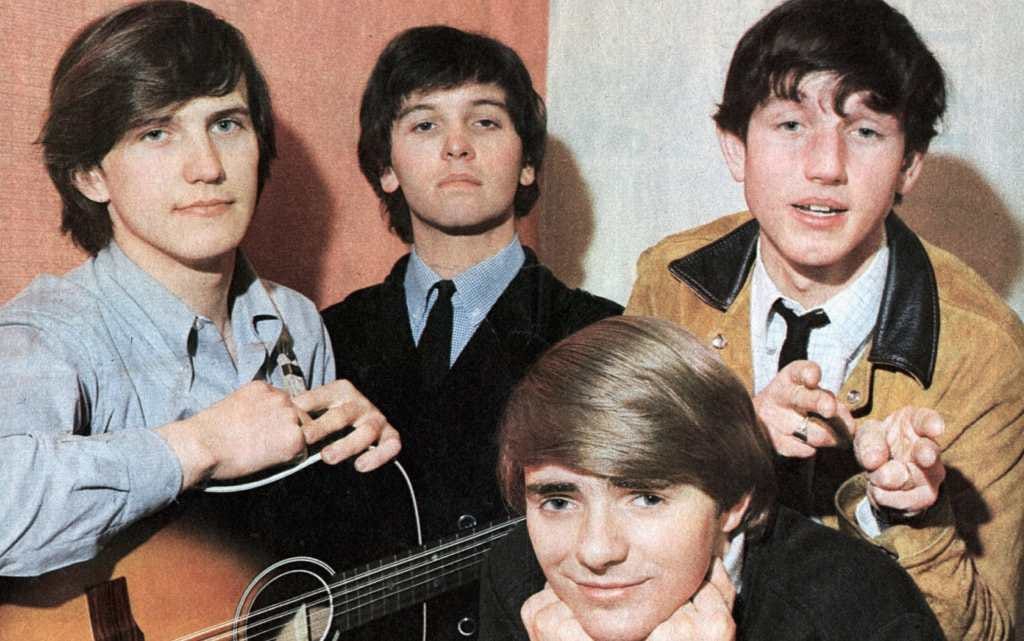
Wayne Fontana and the Mindbenders “Where Have You Been?” (on Wayne Fontana and the Mindbenders, 1965; Manchester, UK “beat group” [Wikipedia]): Opening notes remind me of “Game of Love,” so I’m gonna go out on a limb and guess right off this might be Wayne Fontana and the Mindbenders, who in addition to getting what I believe was their second biggest hit “A Groovy Kind of Love” covered by Phil Collins were the first band I ever heard anybody compare Elvis Costello’s Attractions to, back in I think my high school newspaper The Spectrum after I graduated but before I’d started reviewing records myself. Wasn’t long before I decided the Attractions sounded to me more like ? and the Mysterians, but that’s still definitely the only time I’ve ever hear anybody compare any band to Wayne Fontana and the Mindbenders. Anyway, unlike a few songs ago, this one sounds legitimately ’60s — mid ’60s, to be precise. A sincere little bop with a slight r&b tinge to the singing, about finding someone you’ve been looking for all your life: “Where you been (I bet that’s the title) when I was needing you? Where you been when I was feelin’ blue?” Tambourine in the percussion, high Beatles harmonies. A nice one. 7
Gorillas “I Need Her“ (from Message to the World, 1978; pub/punk band from Hammersmith, UK): Goofy studio squeaks sputter into a much tougher, vibrato-laden ’60s garage spitball where friends tell the singer to dump his gal for somebody new. Could just as easily be an actual Nuggets contemporary or an ’80s revival of the same. If the latter, they really make it believable (and rhythmic), which is rare. 7
The Now “Can You Fix Me Up With Her“ (single and on The Now, both 1979; Bobby Orlando-masterminded NYC powerpop band): Abrupt segue, then yet more sounds from the ’60s. He cruises by the soda shop in his ’57 Chevy, asks “can you fix me up with her”? — Is this really the first song I’ve ever heard with that great title? But okay, there’s too much ’50s nostalgia in the lyrics for this to be ’60s. I bet it’s a post-Raspberries pop rock band, like the Euclid Beach Band from Cleveland. I love how the harmony vocals push it higher and how the guitar harmonizes too, playing the same notes the singer was just singing. Powerpop when it still had actual power, boosted by a sort of Batman-ish guitar figure cruising by in the Batmobile. 7.5
Danielle Dax “Yummer Yummer Man“ (single, 1985, and on Inky Bloaters, 1987, and Dark Adapted Eye, 1988; “experimental rock/post-punk/gothic rock/art pop” [Wikipedia] musician from Essex, UK, formerly in the Lemon Kittens): Galloping start by another garage-ish rock band. High, nasal, sorta slimy, singer guy. “Yuma yuma man, don’t mess with me…yuma yuma man I don’t want to see.” Female la-la-la-la backup counterpoint, wordless, makes it slightly psychedelic, even ominous. “When he comes to get you, you better go along.” Another one that could either be (tail end of) ’60s or decades later, definitely trippier than last few, with an electronic effect that could almost be a theremin. Yet somehow tuneful and poppy anyway, with strange wave-like ocean sounds emerging directly out of the beat, or boat. 7.5
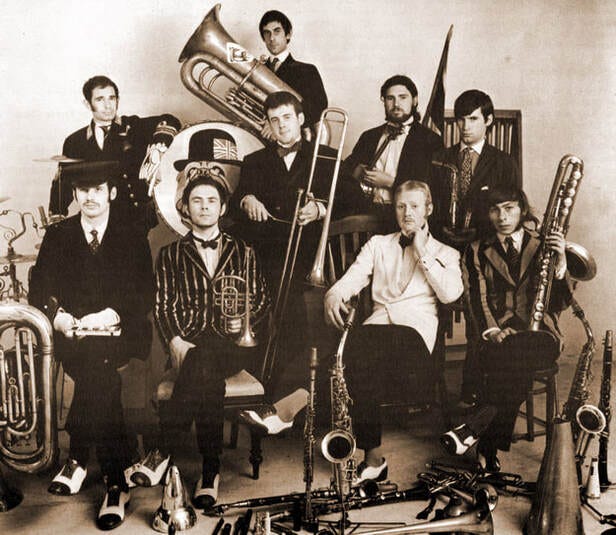
Bonzo Dog Band “Sport (The Odd Boy)“ (on Keynsham, 1969, and several subsequent career retrospectives; “group of British art-school students…combining elements of music hall, trad jazz and psychedelia with surreal humour and avant garde art” who came to public attention through appearances in the Beatles’ 1967 film Magical Mystery Tour and the 1968 TV comedy Do Not Adjust Your Set [Wikipedia]): More trippiness: “Let’s go back to your childhood,” a psychologist urges, repeating “childhood” a few times, fading more each time. Then a sort of Procol Harum piano and what sounds like Jethro Tull flute — So, maybe early prog rock, before the genre excised vestigial pop elements. The melody could almost pass for a Christmas carol. Eventually the guy starts singing what sounds like a madrigal, and there’s a deeper voice that could almost be reciting Shakespeare — they clearly want to sound medieval or thereabouts. Talking voice: “He had a nasty cold over the weekend and still feels a bit stuffy.” But by then it’s British blokes being quirky and whimsical and therefore ultimately a bit precious. There’s life to it, though; it’s not remotely dour. Suddenly switches to a more rock-and-rollish beat and chiming percussion that could conceivably be an entirely new song. 7
Alvin Cash “Doin’ the Ali Shuffle“ (single, 1967, included on Windy City Workout: The Essential Dance Craze Hits & Rarities 1964-73, 2012; St.Louis-born, ultimately Chicago-based “soul-funk-disco singer-songwriter-producer” [discogs] who “also acted in several blaxploitation films” [Wikipedia]): Drumroll, “doing the Olly just for you.” Or “Edgar Allen Shuffle”? “Baby ah baby, doing the Ali just for you!” Oh right — “Ali Shuffle,” which I remember being by somebody named Alvin Cash. One of a number of different Ali records back in the day — “Black Superman – Muhammad Ali” by Johnny Wakelin and the Kinshasa Band, “Ali Bom-Ba-Ye” by Mandrill, “I Am the Greatest!” (a sort of proto-rap poem) by the, well, great man himself. Of course they all involve floating like butterflies and stinging like bees. This one’s hard post-James-Brown ’60s funk-groove soul, with blues guitar picking and horns and “everybody come on now, let’s do it, help me out now, unnngggh!” No qualms about being a novelty dance. 7.5
Wilbert Harrison “Soul Rattler” (from Let’s Work Together, 1969, and on Greatest Classic R&B Hits, 1986; “American rhythm and blues singer, pianist, guitarist and harmonica player” from “Charlotte, North Carolina” [Wikipedia]): Slow sad soul blues chords, organic swamp funk beat, “Cmon over here and get some o’ this.” Race indeterminate. “I’m a soul soul rattler, baby, don’t you leave me, come inside.” Snake as penis metaphor, how very original! 12-bar blues, not that I counted bars or anything. Almost live-sounding shout asides, often low volume, seemingly tossed off — “Better believe it!” “You lookin good baby!” “And I’m not lying!” Yet despite dafonky dabeat, as George Thorogood would no doubt cringeworthily call it, ultimately feels stodgy. 5
The Alan Parsons Project “Eye in the Sky” (single and on Eye in the Sky, 1982, The Best of the Alan Parsons Project, 1983, and later anthologies; London “progressive rock/art rock/progressive pop/soft rock” act “whose core membership consisted of producer, audio engineer, musician and composer Alan Parsons and singer, songwriter and pianist Eric Woofson” [Wikipedia]): Starts gentle and mellow, simultaneously AOR and MOR, probably from the ’80s. Alan Parsons Project, I guess? “Eye in the Sky.” I guess the eye in the sky now is the Internet, or AI — reads your mind, right? I get the idea Parsons has developed some level of critical cachet with the indie-rock generation in recent years (actually, starting way back with Grandaddy’s almost-quarter-century-old Christmas single “Alan Parsons in a Winter Wonderland”), I suppose because of his synth technique– i.e., he didn’t use it for rhythm, just coloring maybe? — and not needing a gauche rock band. Indie rock loves its solitary studio geniuses. Have been curious whether any APP stuff was interesting — it used to fly right by me back in my AOR listening days. But as AOR goes, this is at least competent. A pinch of Daryl Hall blue eyed soul in the vocal makes it borderline yacht-rockish. Otherwise, I’d call it “art pop,” but not nearly as clever or entertaining about it as 10cc, ELO, even Supertramp. I’d put Gary Wright, another subject for future research, in the same category, not that I’ve ever bothered picking up an LP by either from a dollar bin, where their records have always been quite plentiful. Then again I never really got Pink Floyd either. Meh. 5.5
Spandau Ballet “The Freeze” (Single and on Journeys to Glory, 1981, and later best-ofs; London synth-pop/new romantic band): Ticky tock of the rhythm make the opening rock guitar sound new wave. Beat skims ska, singer (male) sounds vaporous. Within half a minute it’s clear nothing’s rock about it at all; that opening riff was a tease. Singer could use a drink of water. The bridge, slightly extended and occurring twice, hints at playful; once, a ghost howls through. 5
Rococo “Blue Movie Star“ (collected or possibly re-recorded on The Living Rock, 2002, Losing Ground, 2014, and the 2021 Grapefruit UK box set Oh! You Pretty Things (Glam Queens And Street Urchins 1970-76); London progressive rock band who, according to Wikipedia, released two singles but no albums in the ’70s): Little stabs of possibly electronic beat under what sounds like a high pitched male doing an almost Geddy Lee thing. First thought was artsy Boston hardcore band the Proletariat, probably a major stretch. “He’s. a blue movie star” — See “Blue Money” by Van Morrison and “Tit Photographer Blues” by Fabulous Poodles. Intermittent ticking clock rhythm. I’d graph the vocal midway between prog and glam, with pop a minor third vector. 5.5
Ides of March “Factory Band“ (on Vehicle, 1970; Chicago garage band whose “sound progressed through psychedelic pop rock, and blue eyed soul,” then “jazz-rock” [discogs], after which frontman Jim Peterik went on to front Survivor): Post-Chuck Berry rhythm, or is it rockabilly? Rolling on the river, sounds like, and as soon as I typed that they talked about a river boat with its whistle blowing — tradition of not just Creedence’s (then Ike and Tina’s) “Proud Mary” but also Elton John’s “Dixie Lily” and maybe even Leon Russell’s “Delta Lady” or Mountain’s “Mississippi Queen,” if the women in those songs are metaphors. Another somewhat stodgy roots quest. “When the music starts, get on your toes,” and stuff about foot-stomping, which I hope does not mean your toes get stomped on — regardless, a dance number. Blue collar factory references suggest Brownsville Station in one of their less raucous moments. Fun handclap part near the end could be Cub Koda and Co. too — So okay, maybe not that stodgy. 6
Bobby Womack and Patti Labelle “Love Has Finally Come at Last” (1983 single, on Womack’s 1984 The Poet II and later best-of sets and also on The Essential Patti Labelle, 2008): Love is gonna come at last — ’80s r&b for grown folks? Or “finally come at last,” which would be redundant. That’s the chorus, after which the deep lead male voice comes in, then a woman whose soul is almost as deep though her voice isn’t. Maybe she’s Patti Labelle? I’m sure the man isn’t Luther Vandross. Alexander O’Neal is more likely, though I don’t think it’s him either. Whoever it is, he’s a more distinctive, and I’d argue better, singer than his partner — she’s good too, but I’m thinking fairly replaceable, interchangeable. He’s not. You can hear the farm in his delivery, the South, the cotton fields, the ham hocks, the church too obviously. Pretty sure this was a huge r&b hit, though I can’t remember who did it. A smooth sax sways in; maybe David Sanborn, since he seems to have played on most everything? Male singer later does preacher-style asides. He’s gruff. Teddy Pendergrass? Turns out I am not real good, maybe frightfully bad, at identifying r&b vocalists. 7.5
Stavely Makepeace “Don’t Ride a Paula Pillion“ (1972 single B-side, included on the 2023 Cherry Red UK digital compilation Spark Singles: 1970-1972; Coventry, UK, “eccentric pop” band whose music “reflected their obsession with producer Joe Meek” and who spun off the novelty group Lieutenant Pigeon [Wikipedia]): Mumbly vocal mixed way back, behind a stunted attempt at Caribbean lilt. If not for that shunning of fidelity, I might guess it’s some kind of ’80s British soul funk. There are a few whistling breaks, and what sounds like a steel drum in the percussion. Interesting how the singer stretches “dont cryyyyy”, but beyond that I don’t get many words. Maybe it’s this ’80s British reggae group called X-O-Dus — whose recordings, as I recall, were mostly demos. That would explain the lo-finess. 6
The Youngbloods “C.C. Rider” (on The Youngbloods, 1967, The Best of the Youngbloods, 1970, and later best-ofs; Greenwich Village, NYC folk/psychedelic rock band): More swamp-country soul — “C.C. Rider,” a song I mainly know from Mitch Ryder’s version. “Look what ya done done,” they say, and something about “3 times 70, you know what you wanna do.” That makes…210?? A honky sax. “Blues ain’t nothing but a good woman on your mind”? Something like that. Run of the mill blues guitar solo, but at least it’s not long, and it’s in the service of a concrete song. Albeit one everybody’s heard already. 5.5
Helter Skelter “Goodbye Baby“ (1971 recording, 1977 single B-side, included on 2017 President UK compilation Hey! 1970s Rock ‘N’ Glam From The President Jukebox; Hammersmith, UK, glam/proto-punk/pub-rock band that evolved out of Crushed Butler and into the Hammersmith Gorillas): Hungry boogie chords, building to an almost Sladely stomp, though the singer is definitely no Noddy Holder. He sings English cliches, ho hum macho dork lyrics — “Your wicked ways show in your eyes” — in what sounds like a Scandinavian or German accent. Drums bang, but there’s not much push. Elements could’ve added up to a decent mid ’70s hard rock song, but this ain’t it. 5.5
Theatre of Hate “Rebel Without a Brain“ (1981 single, included on Revolution, 1984; ; London post-punk band, half of whom evolved into Spear Of Destiny): Slow dark heavy Killing Joke-like goth-metal post-punk rumble, beneath a clearly British voice: “My God, my liiiiiiiiiiiife” or is it “liiiiiiight”? A horn line seems to follow the guitar line, or is it a guitar that sounds like a horn? Gargantuan hollowed-out oil-barrel drums, hitting like shotgun blasts or bombs detonating in rhythm. Lots of extended vowels, no clue about the title. In the final 10 seconds or so, some intriguing orchestrated movie-soundtrack effects. 6
Cold Chisel “Rising Sun“ (on East, 1980, then subsequent best-of collections; Adelaide, Australia, pub/hard rock band): Another Chuck Berry riff, propelling hopped-up Dave Edmundsish pub-rockabilly. “The Rising Sun just stole my girl away,” so he’s gonna steal her back again, which he pronounces “errgayun,” in an exaggerated sort of Elvis quiver. Could be Count Bishops, but more likely this is their Australian equivalent Cold Chisel. Lyric reminds me of the Ramones song about the KKK taking Joey’s baby away, which may or may not have been about a racist bandmate. Here, I wonder if the singer’s girlfriend just decided to stay in Tokyo, or if she met a Japanese boyfriend who was an improvement. Or maybe it’s some deeper allegory about the South Pacific relationship between Oceania and the Far East. Either way, there are also some Jerry Lee piano runs. So, if not rockablily per sé, definitely rockabilly-adjacent hard rock. And it does rock. And roll. 7
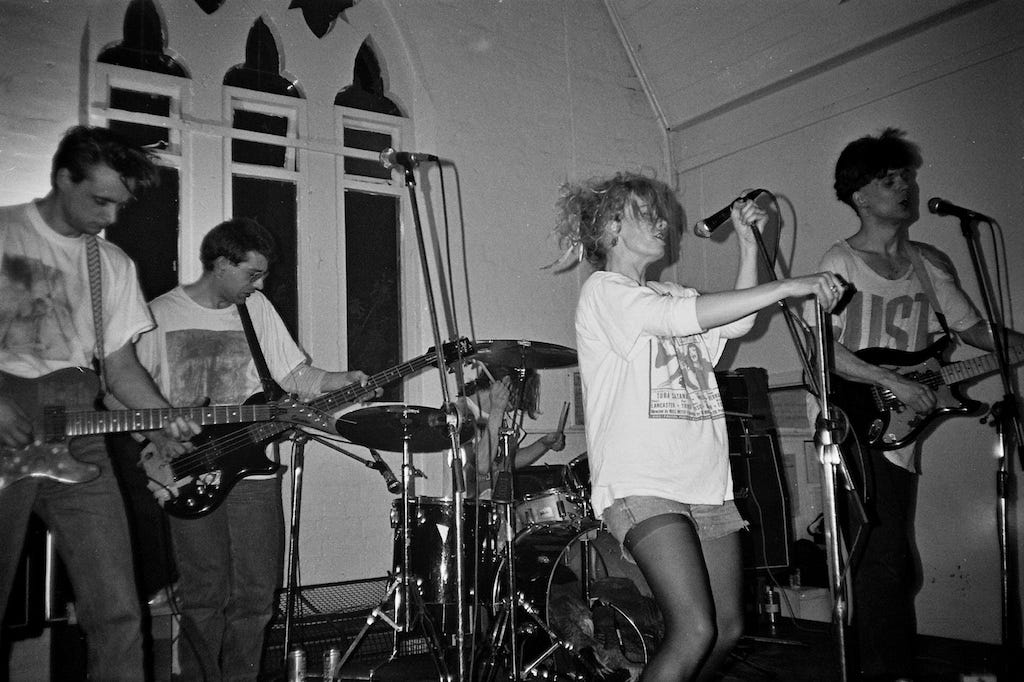
A.C. Temple “Sundown Pet Corner“ (from Sourpuss, 1989; Sheffield, UK, “alternative rock band… mixing industrial noise with guitars and effects” [Wikipedia]): Background environmental factory noise, though not a mechanical rhythm exactly, with singing emerging from din á la Bad Moon Rising-era Sonic Youth. And just like SY back then, the noise has beauty in it, even if it’s really just goth schlock schtick when you get down to it. Specifically, this sounds like one of those songs where Kim Gordon seemed to be echoing deep inside a cave. If the guitarists are no Moore and Ranaldo, that doesn’t bug me. A distant low woman’s voice says something about “walking around”; not sure if she’s the same woman as the main, higher pitched one. Occasionally breaks for noisy elevator Muzak — proto-shoegaze? 6.5
Caroliner Rainbow Splinter Mine Deserves “Epic of the Well Meaning and the Thick Blooded” (on 1996 Scratch Canada compilation Sidereal Rest: The Sleep Vehicle; one of countless aliases of the San Francisco band Caroliner — “described by critics as ‘industrial-bluegrass,’ the group uses instruments from bluegrass and rock traditions, as well as homemade electronics and other modified instruments” [Wikipedia]): Whooshing wind, whirling propellors, seagulls. Then backporch plucking at odd angles; honestly wasn’t sure the backporch was the same song until the windstorm came back, and things starting switching back and forth. So we’re on a porch in a rainstorm, cool! Or maybe during a war, one or the other. Or both. No doubt some people took banjos to Vietnam, right? Bluegrass on a rice paddy. Caroliner Rainbow? Not really what you’d call a song, but that’s fine. Gets all quiet, seems to stop; is it over? Okay I guess it is. 6.5
via facebook (responses to pre-update, Mellencamp-less 2020 version when I was still combining 1990 with 1991):
Chuck Eddy
Jaz, there was even adult alternative mainstream country marketed to a yuppie-type demographic: Lyle Lovett, k.d. lang, K.T. Oslin (who has the highest country album on my list), Mary Chapin Carpenter, Steve Earle, Dwight Yoakam, the Mavericks. Those all got played on country stations! And I’m sure I’m forgetting others. Then Garth and Shania came around, I guess, and proved there were more profitable ways to define the genre.
Steve Pick
Chuck Eddy and I loved all the artists you name here and hated Garth Brooks for wiping them off the radio. However, once Shania came along I was and remain completely on boardvia facebook (responses to pre-update, Mellencamp-less 2020 version when I was still combining 1990 with 1991):
Steve Pick
Pavement remains a bete noire for me only slightly below Nirvana. P.M. Dawn is interesting – I loved them at the time, haven’t played them in 25 years. After I saw them live in ’93, a show astounding in its breadth and depth, the records never sounded as good to me.
I just checked my best of list for 1991 – you didn’t pick any of these, all of which hold up for me, a couple of which – the John Prine and the Willie Nile – are in contention for any list I’d make for the whole decade.
Image may contain: 8 people, text that says ‘STEVE PICK Pick’s Picks: Not The 10 Best But The 20 Best Of1991
[Here Steve posted a column featuring albums by Elvis Costello, Marshall Crenshaw, Get a Life, Jimmie Dale Gilmore, Peter Holsapple and Chis Stamey, John Lee Hooker, the La’s, John Mellencamp, Van Morrison, Aaron Neville, Willie Nile, Graham Parker, Pere Ubu, John Prine, Public Enemy, Chris Smither, Matthew Sweet, Richard Thompson, Voice of the Beehive, and Neil Young.]
Mike Freedberg
Any list with John Lee Hooker in it deserves a salute
Chuck Eddy
Interesting, Steve. Guess I never had much taste for what I’d call Adult Alternative music (NPR music? WXPN music, since I lived in Philly at the time?) in the ’90s. I’m sure there are exceptions (hey, a Roches Xmas album and the soundtrack to a Ken Burns Civil War documentary both made my 1990 top 50!), but they’re admittedly few and far between. Most tended to strike me as staid, stodgy, genteel, whatever. And I know I’m speaking in generalities. But for example, I LOVE early John Cougar way more than any sane person should, but I can probably count the post-Lonesome Jubilee Mellencamp songs I care about on one hand. And I’ve never really connected with Elvis Costello since, like, Trust. P.M. Dawn, just about as Adult Alternative as hip-hop ever got unless Arrested Development count, only just barely hold up for me — Which is why they’re so low on the list. Several rap albums ranked higher. Mainly, I like their pretty singles I guess, and the sweetness of their ambition. And apparently I feel about Pere Ubu (whose mid ’70s singles and first two albums rank with my favorite music ever) and Pavement (who I basically stop having a use for after their first few singing-through-a-broken-Burger-King-drivethrough-intercom EPs) the way you feel about Inscoc. Who are a weird case: Their first album, which was their big one, never meant much to me. But the flop-selling followup, which I suspect is more arty than you’d expect though maybe not the way their early indie stuff was, is to me their great one. I’ll try to track down what I wrote about it in Spin a few years ago (Google isn’t helping), but suffice it to say it goes every which way dance-genre-wise (house, freestyle, etc.) way more cleverly than most such patchworks.
Jaz Jacobi
I keep trying to explain to people how much, maybe before “adult alternative” was a commonplace marketing term, watching VH1 around 1989 made me wonder if there really was a big market for “NPR/genteel” rock for grown-ups, kind of a window of yuppification maybe before the Garth Brooks-era wave of country being so big with that demographic. I remember seeing seeing so many music videos in rotation that seemed to have almost zero radio presence in the rural Midwest, anyway: Julia Fordham, Syd Straw, pre-hit Chris Isaak, Julee Cruise, Tuck & Patti, Richard Thompson, stuff like that–once I ever saw pre-Mazzy Star obscuro-indie act Opal’s video on a Sunday afternoon. This was right around when Alannah Myles and Marc Cohen hit pay dirt with semi-AOR big-production power ballad-ish tunes, and Hair Club for Men candidates like Paul Simon or Mark Knopfler were still credible hitmakers on a certain level, so maybe someone figured the moment was ripe for a sort of post-“rawk” rock for middle-aged audiences–funny, since years down the road I stopped seeing much distinction between MTV being “for the kids” and VH1 being for their parents, in terms of musical selection, i.e. both were playing Metallica [maybe not hip-hop?]. This also was around when “world beat” was being pushed in a significant manner, perhaps post-GRACELAND being the prime moment for that; VH1 had a show hosted by Nile Rodgers that was on five times a week, each day focusing on a different genre [world, jazz, etc.].
Steve Pick
Chuck Eddy, since I’m two years older than you (and thus was a worldly 33 when I wrote the piece I shared), I of course was always more mature than you. Seriously, though, I remember very much thinking that rock music (and its associated offshoots) was growing up, and that it would be for adults from then on. This was largely the reason Nirvana hit me like a ton of bricks falling on my head – when I saw 13-year-old girls reenacting their SNL appearance the morning after it aired, I kind of knew that all my favorite music was never going to be popular. I kept on pursuing the dream for a while, trying to convince people through what I wrote – within two years, though, I was much more interested in Betty Boo, Dee-Lite, Janet Jackson, and TLC. Over the years, I managed to come to the conclusion that I’m interested in a wide range of music without worrying about its popularity, which I suppose is part of the reason there’s no market out there for me as a critic any more. I do know, though, that you and I have similar tastes in music from 1977, and I like more things you recommend in recent years, so the wide disparity in our 90s interests doesn’t seem as important as it maybe did back then.
Chuck Eddy
Jaz, there was even adult alternative mainstream country marketed to a yuppie-type demographic: Lyle Lovett, k.d. lang, K.T. Oslin (who has the highest country album on my list), Mary Chapin Carpenter, Steve Earle, Dwight Yoakam, the Mavericks. Those all got played on country stations! And I’m sure I’m forgetting others. Then Garth and Shania came around, I guess, and proved there were more profitable ways to define the genre.
Steve Pick
Chuck Eddy and I loved all the artists you name here and hated Garth Brooks for wiping them off the radio. However, once Shania came along I was and remain completely on board
via facebook
Steve Pick
Your list has even more records I don’t know that seem likely to be good if I’d ever hear them than usual. I really never liked Nirvana, though. There are easily 150 records you left off your list better than Nevermind, even if you think there were only 133 better ones you named. I’ll never forget the sinking feeling, though, the morning after their appearance on Saturday Night Live, when I was working in the record store by myself doing upstocking and figuring out which albums needed to be ordered with the new computer Billboard magazine bought us so that we could be an indie store reporting for Soundscan. Three 13-year-old girls were out in front of the store acting out every move Cobain and Novoselic had done on TV. I instantly realized that despite his top 40 hit a couple years earlier with “Veronica,” Elvis Costello was never going to be a big star. And the rock music I loved – which included Poi Dog Pondering at the time – was now being superseded by a younger generation (though I maintain the Steve Pick Experience, an amateurish hardcore band I was in back in 1985, was only a little bit less developed at doing the same kind of music Nirvana did.)
I don’t remember how considered it was, but I did review your book that year in the St. Louis Post-Dispatch. I also reviewed Douglas Coupland’s book that year in SurFace, an attempt to start a cultural arts newspaper here in St. Louis that lasted a handful of months. I distinctly remember thinking – at last, a book about my generation, the one born in 1958 (like Michael Jackson, Prince, and Madonna), because Coupland’s theme was that we had grown up being told about all these great things our older peers were getting into, and by the time we were old enough to do them, they were no longer the idealistic searching for freedom things they had seemed to be.
Chuck Eddy
So, did you consider yourself Generation X at that point? I’m curious when that changed, who made the decision, and why! It’s so weird that it did.
Steve Pick
absolutely. To this day it annoys me when people insist I’m a Boomer instead.