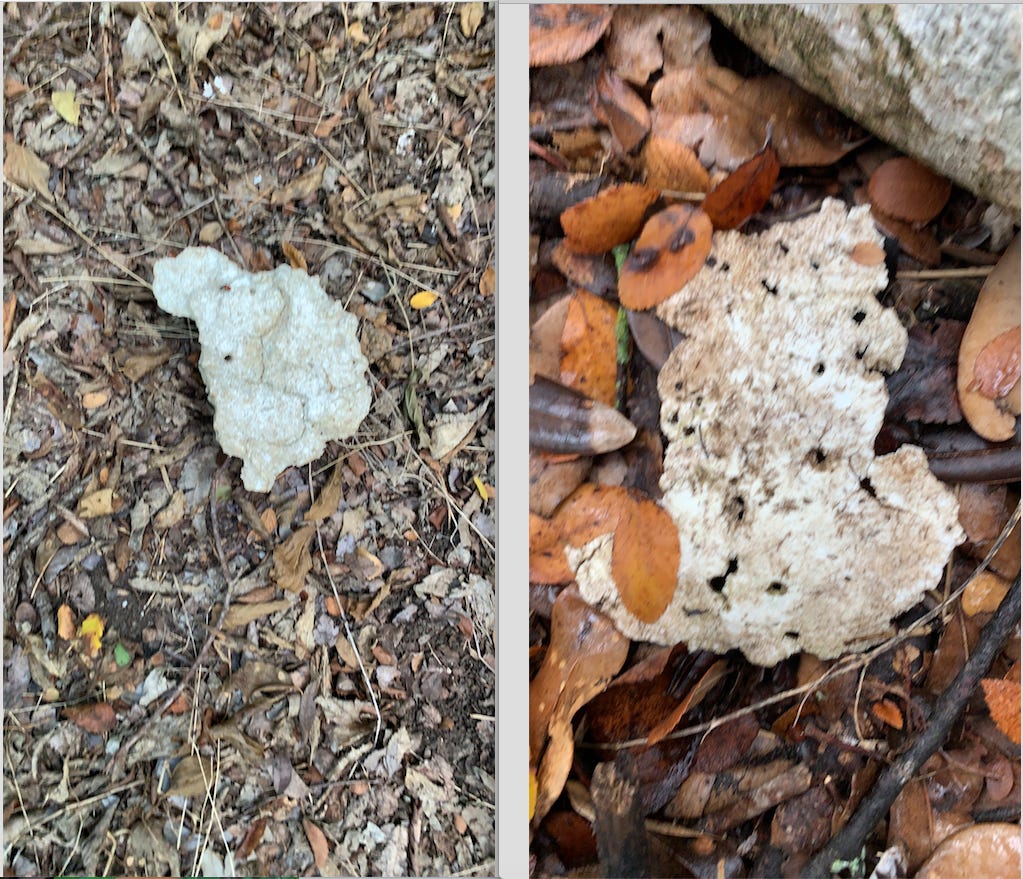
Desperately Seeking Fungi
Identifying guesses still not quite "educated," but at least I have a system


First time in a long while that I’ve put together one of these posts where I ineptly attempt to identify varieties of fungi I took pictures of in the woods. But this time, I actually have a system! Basically when I see a fungus I’m intrigued by, I photograph it using my phone’s iNaturalist Seek app, and let the app label the specimen for me. Sometimes I have to hold my phone there for a bit while it cycles from general classifications to a specific organism, but increasingly the app lands on something.
Whether it’s correct or not is another question of course, but at least it gives me a place (or, occasionally, two contradictory places) to start. At that point, I call up reference books and websites, and look up whatever Seek calls the thing. As always, if you know more than I do and want to tell me which of these are right or wrong, by all means go ahead. And I apologize if any of the species below already showed up in previous fungus posts here. I still don’t trust my judgement nearly enough to try eating any of this stuff. And it’s interesting that colloquial names for two of these involve the hands of men who are dead. The last one, at the bottom, isn’t even a fungus at all.
**********
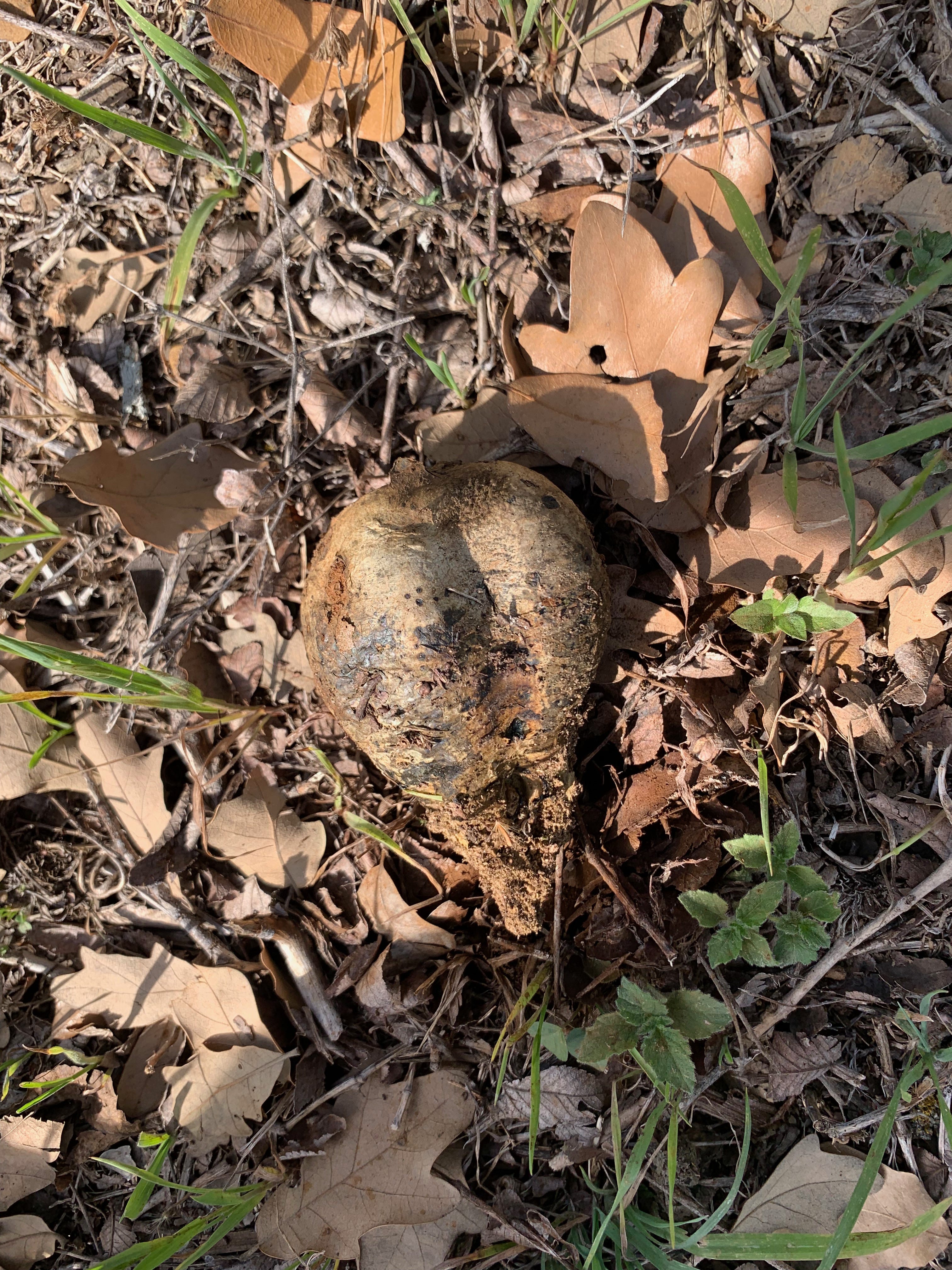
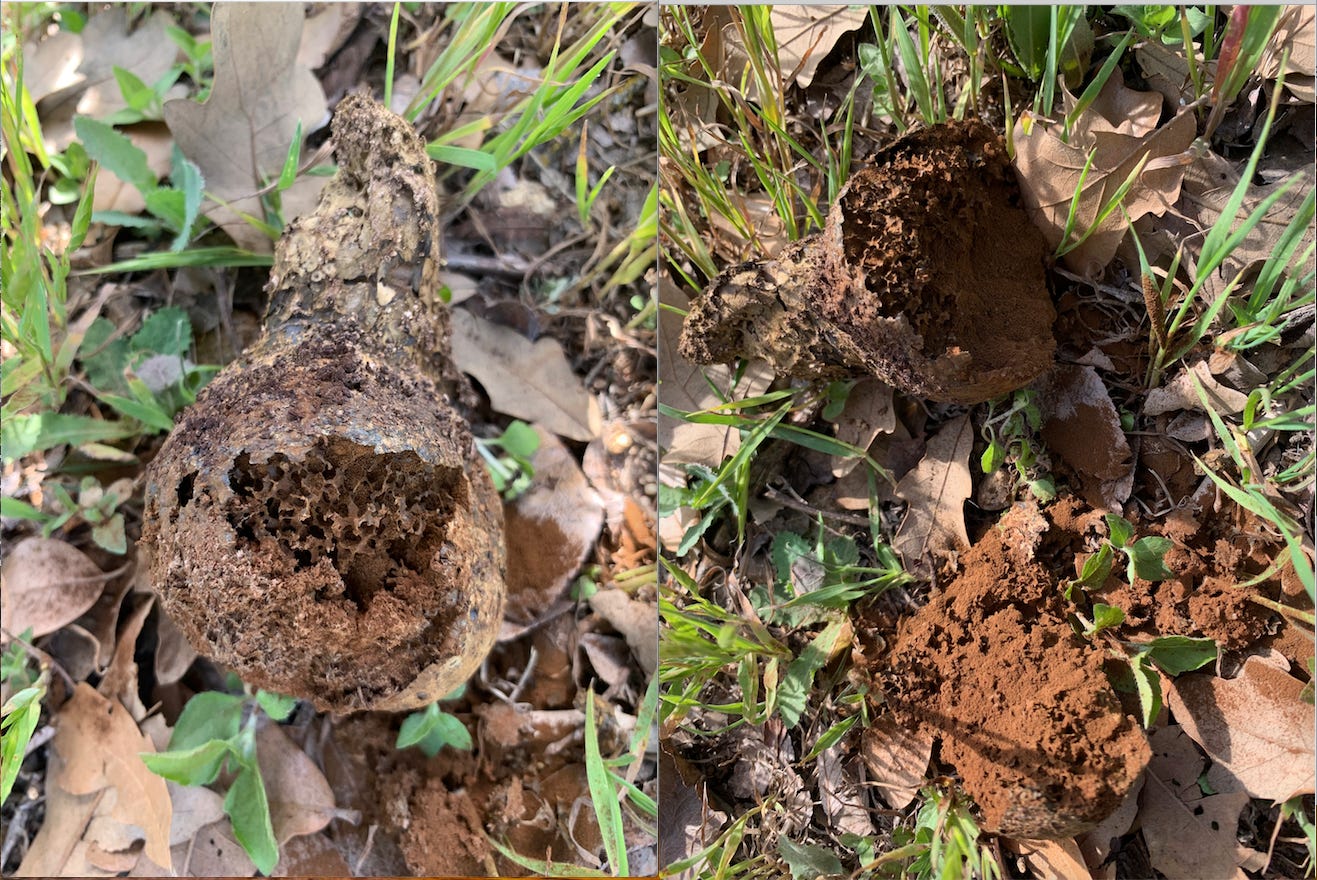
Dog Turd Fungus aka Dead Man’s Fist aka Dyemaker’s Puffball (Pisolithus tinctorius): “Puffball made up of peridioles that are pealike compartments embedded in a blackish gelatinous material…In the ‘wild’ it resembles a dirty tennis ball, half buried in dry sand. The outer layer is gray-brown and pitted and has a narrow, rooted base.” (Susan Metzler and Van Metzler, Texas Mushrooms: A Field Guide, 2017 printing)
**********
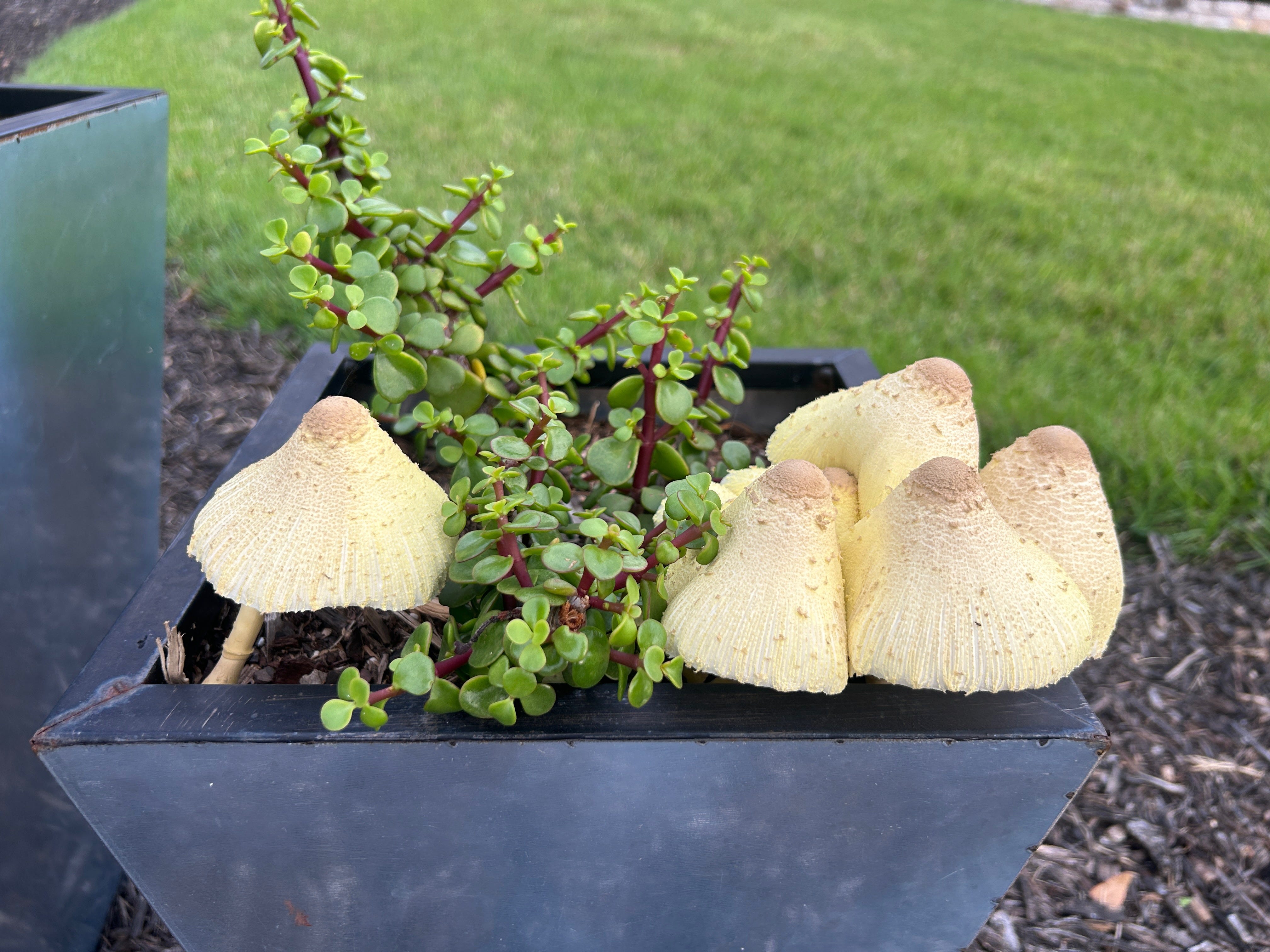
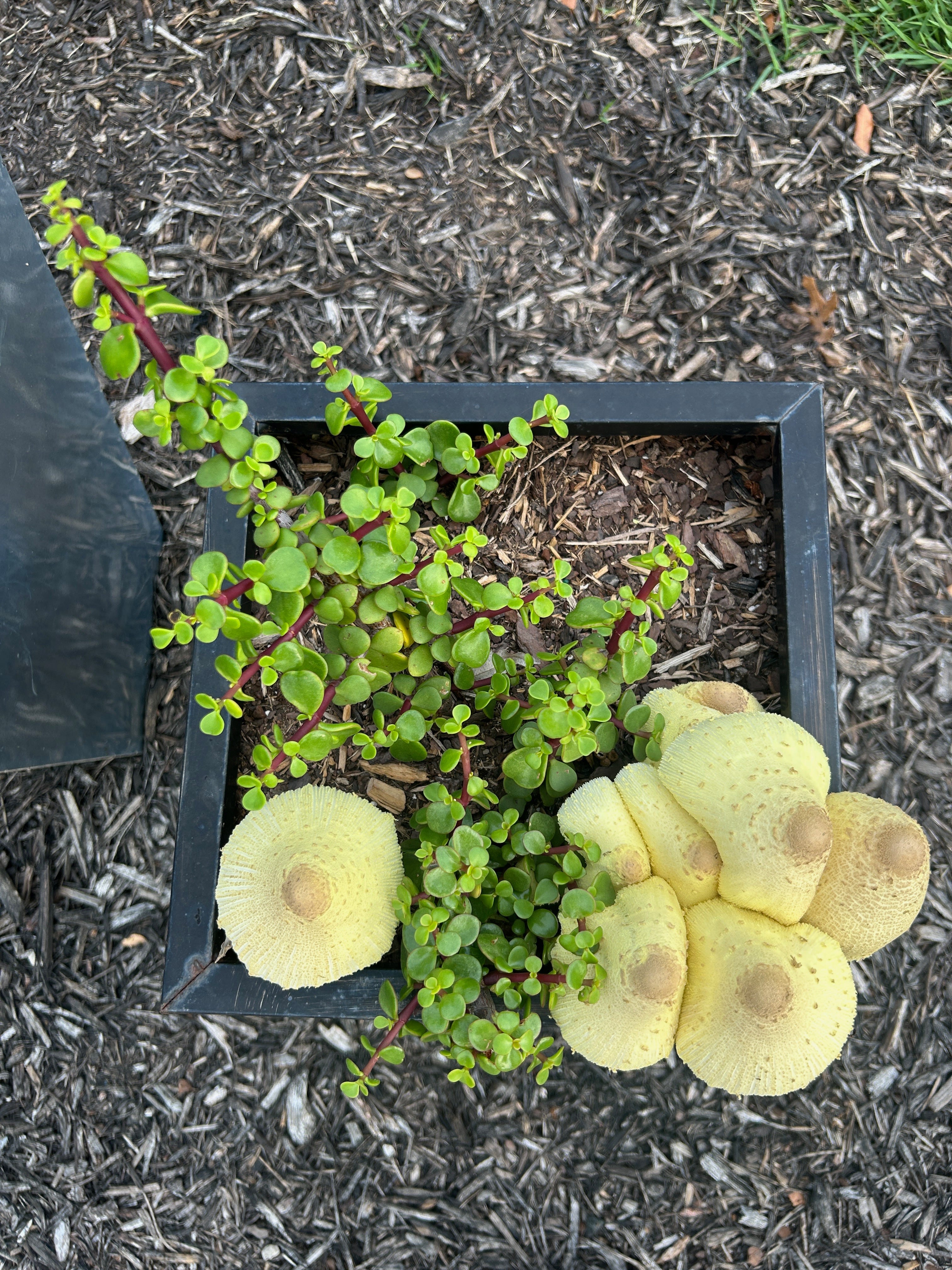
Flowerpot parasol aka Yellow parasol aka Plantpot dapperling (Leucocoprinus birnbaumii): “Best known for its occurrence in flowerpots and greenhouses, but also widespread and common throughout the southern United States. Its yellow coloring is very distinctive. The cap is grooved-plicate at the margin.” (Thomas Læssøe, Mushrooms: How to Identify and Gather Wild Mushrooms and Other Fungi, 2012)
*********
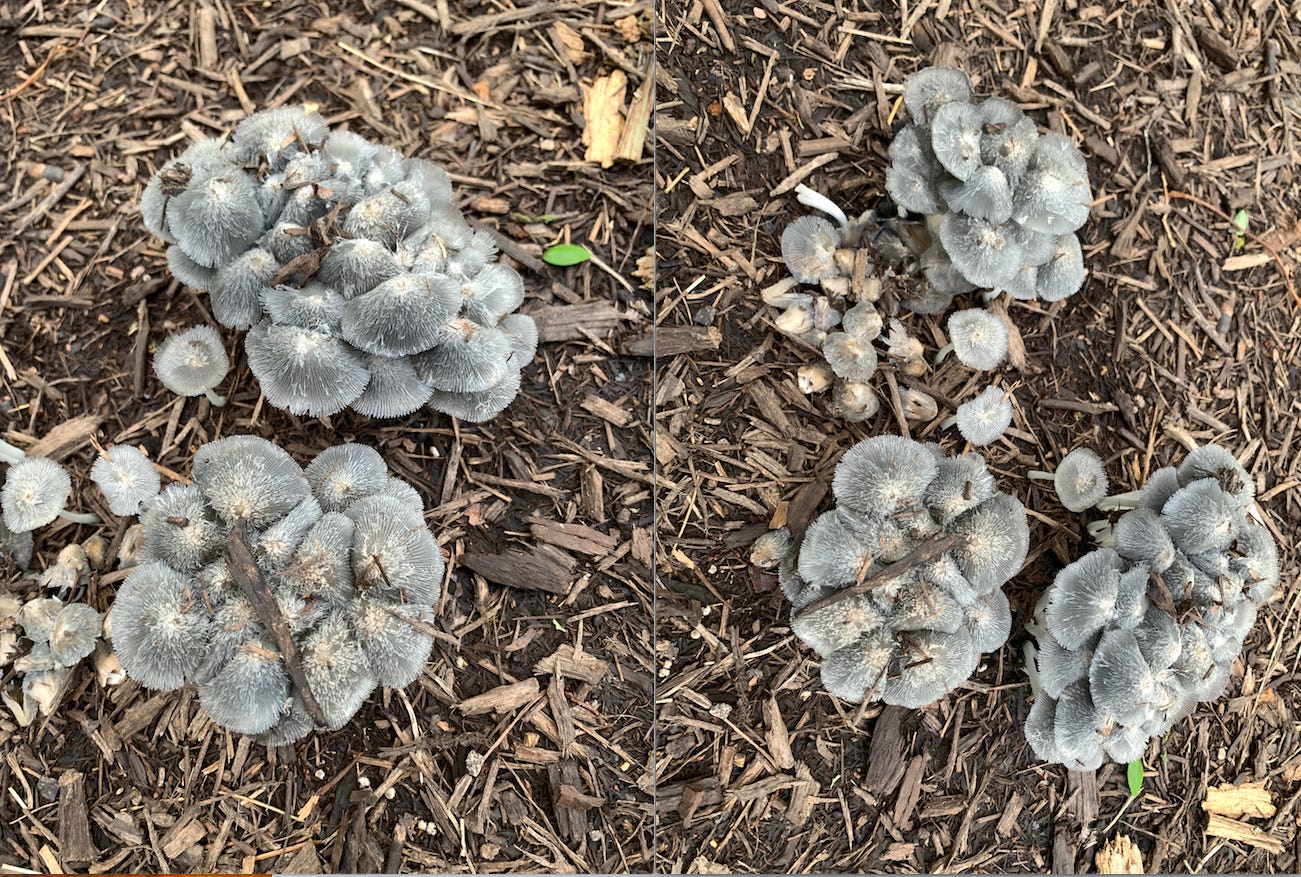
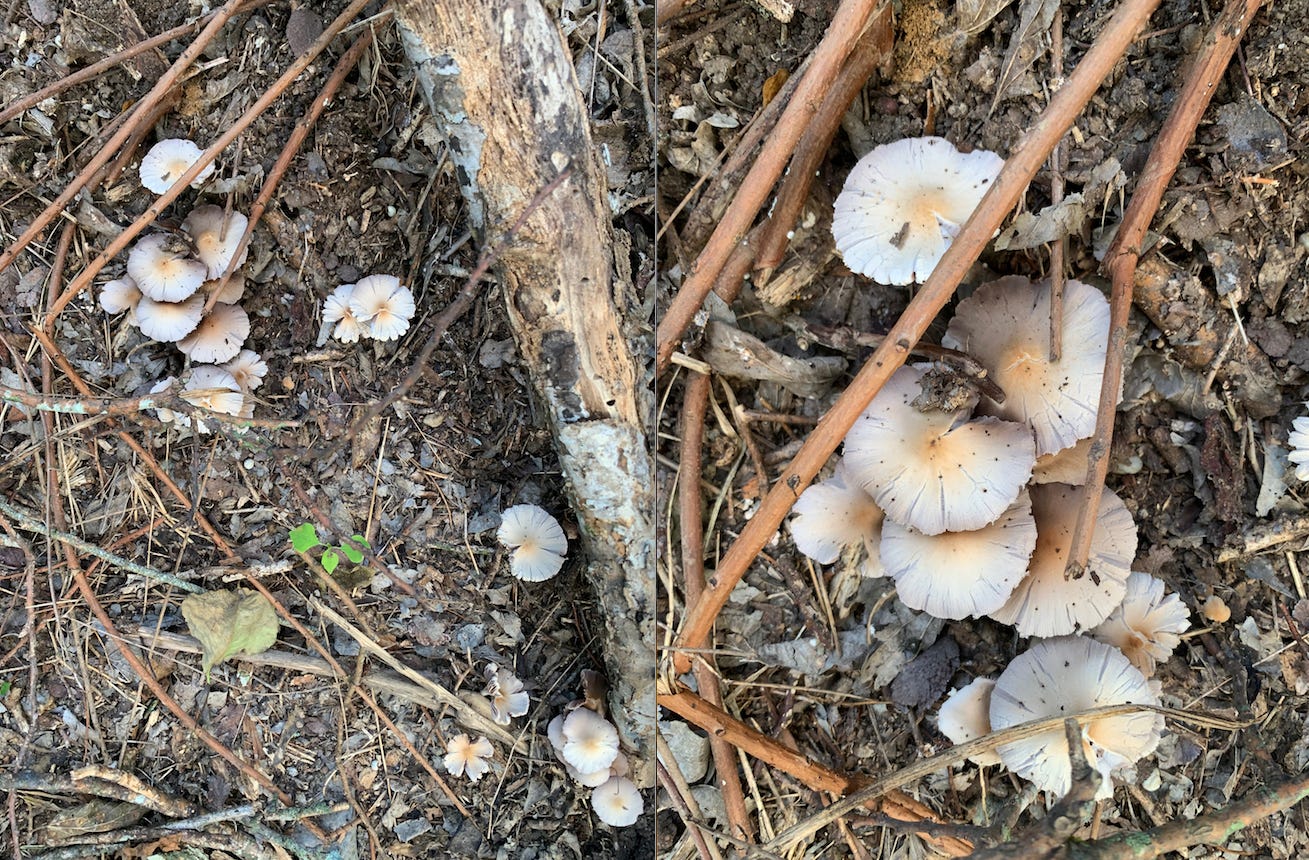
Hare’s Foot Inkcap aka Rabbit’s Foot Inky Cap (Coprinopsis lagopus): “Gets its common English name from the way the young ‘furry-like’ fruiting body is reminiscent of a hare’s foot – albeit poking up from the ground. This Inkcap mushroom is usually found in small groups and matures into relatively tall specimens (up to 12 or 13 cm in some cases). They’re usually found on soil or leaf litter in woodland (sometimes in rarer field scenarios). But quite often, as in this case, they especially seem to enjoy taking to wherever there has been man made disturbance in woodland. There had been a huge pile of woodchip/bark mulch, left by the recent activity of forestry workers. There were dozens of them, in several groups spread across one side of the large mound. The white(ish) veil remnants are numerous on the young caps, which are very delicate and disappear on handling.” (Mushroom Diary — And sure enough, the ones I found were also spread all over, growing through wood chips and mulch up and down a trail winding through a wooded area that is currently being turned into a park, which has involved lots of excavation and path-building.)
**********
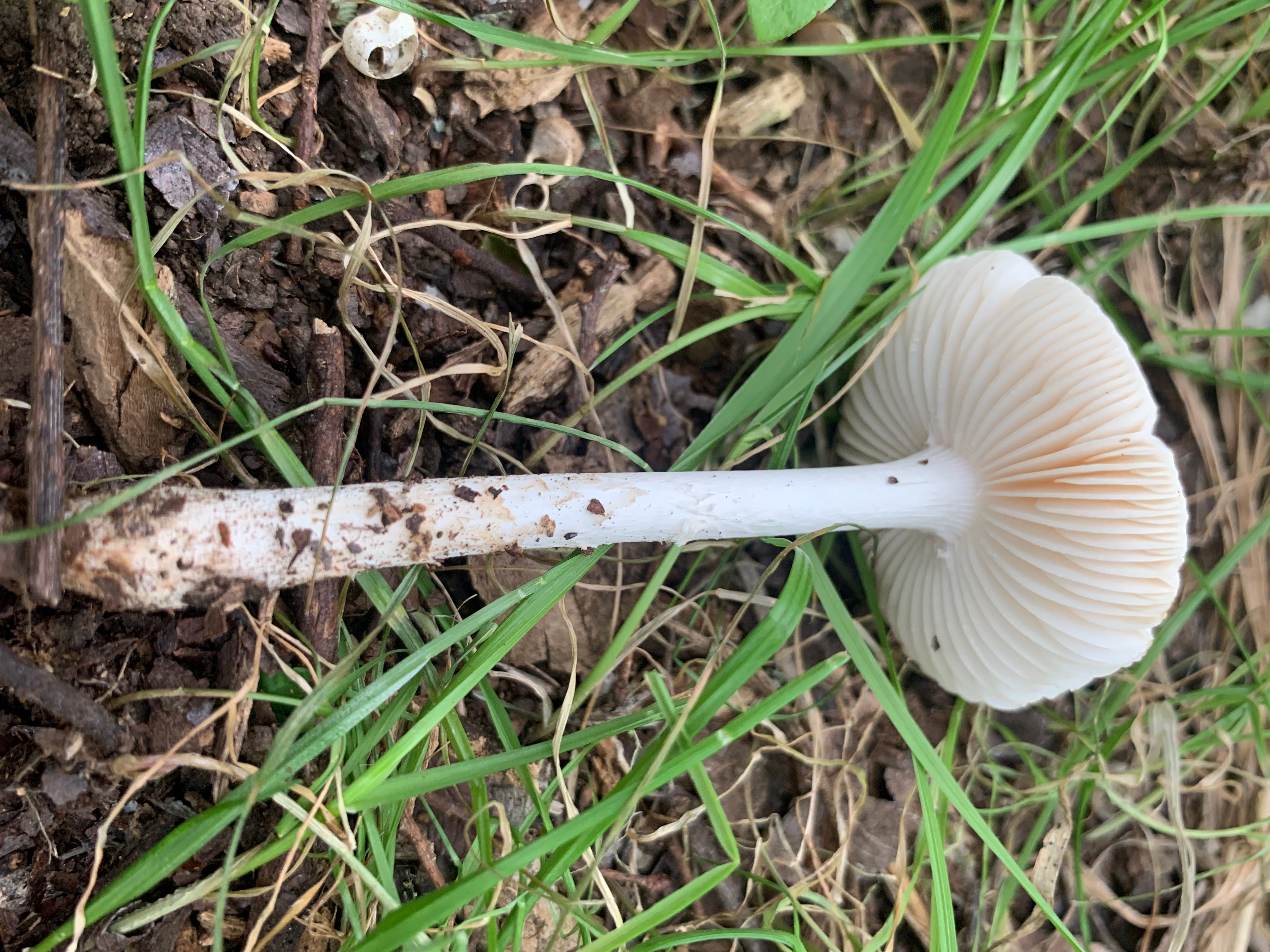
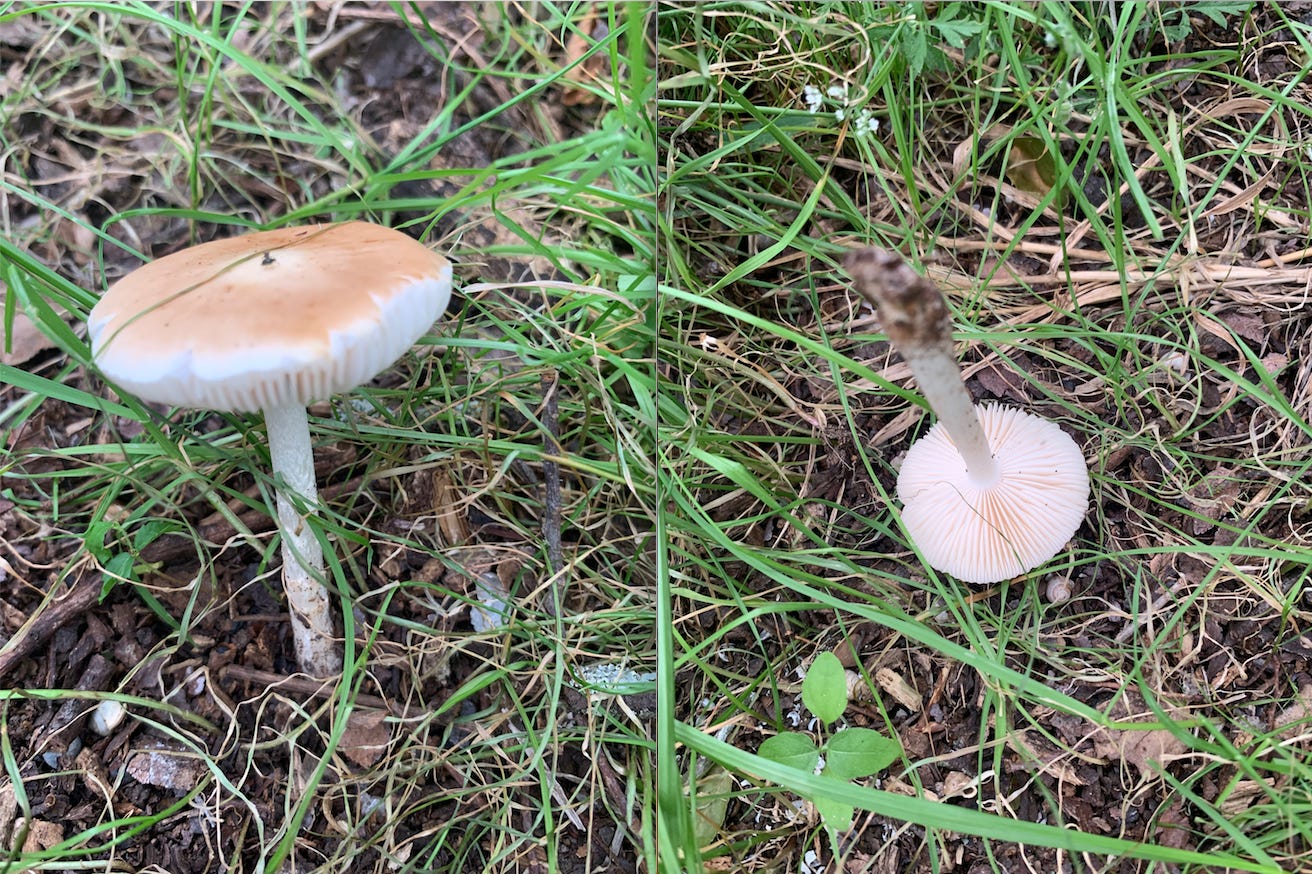
Beech rooter aka rooting shank (Hymenopellis radicata): “With a bit of care and a digging tool, the very impressive rooting stem can be excavated and the tree roots from which they grow can be located. Unlike some lookalikes, such as Xerula pudens and X. caussei, the cap of Hymenopellis radicata is greasy, especially in wet weather.” (Læssøe) (I’m not positive that’s what this is, but given the appearance of the gills on the underside of the cap, it’s definitely more likely a beech rooter than a Ruby bolette [Hortiboletus rubellus], which my seek app also tried to identify it as. Looking at photos of those two Xerula species on line, I’d say it’s also more likely Hymenopelli than them as well. And you have to admit the cap does indeed appear to be somewhat “greasy.”)
*********
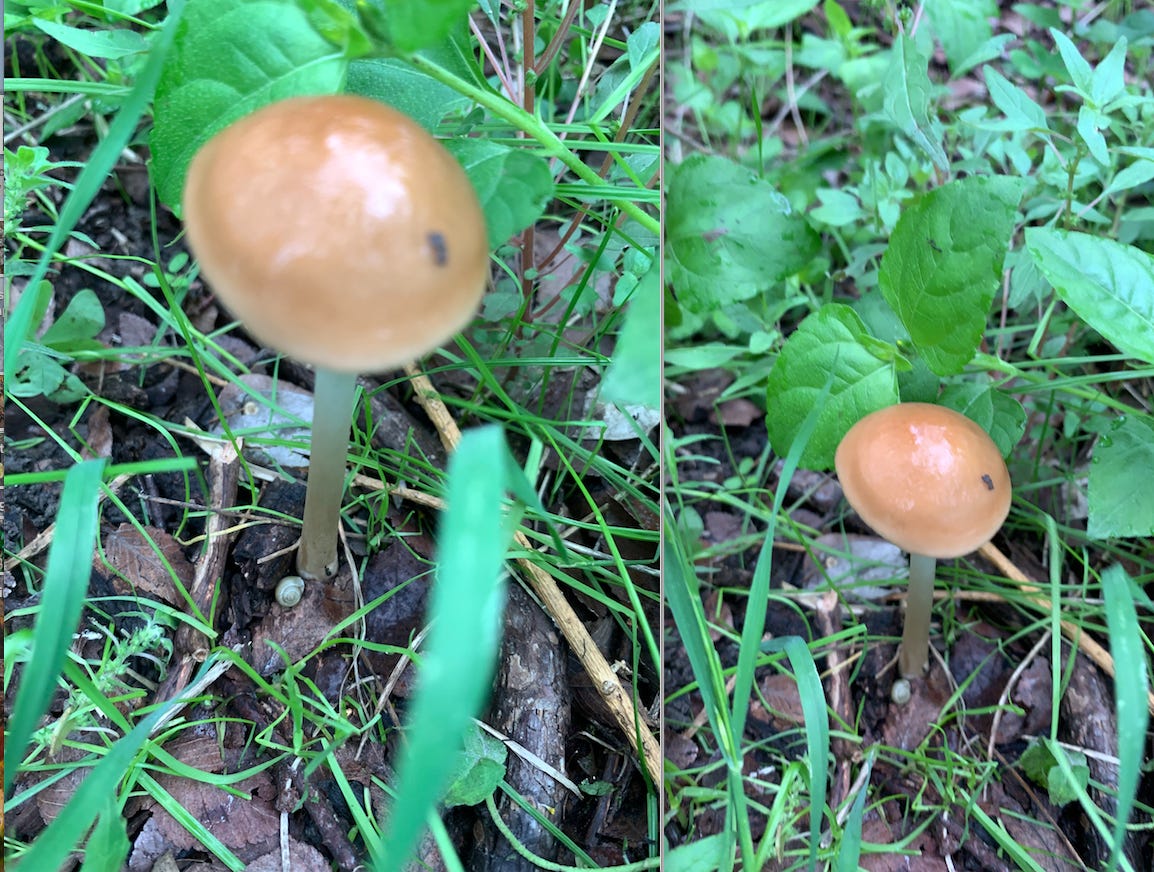
Pale Brittlestem aka White Brittle-head (Candolleomyces candolleanus): “Often found in gardens and parks. The yellow-brown caps..dry out rapidly to an ivory white and the threadlike veil disappears, leaving an almost smooth cap. True to its name, this species is extremely brittle when dry. As the spores mature, the gills undergo a change in color, from white when young, through lilac and brown when mature.” (Læssøe)
***********
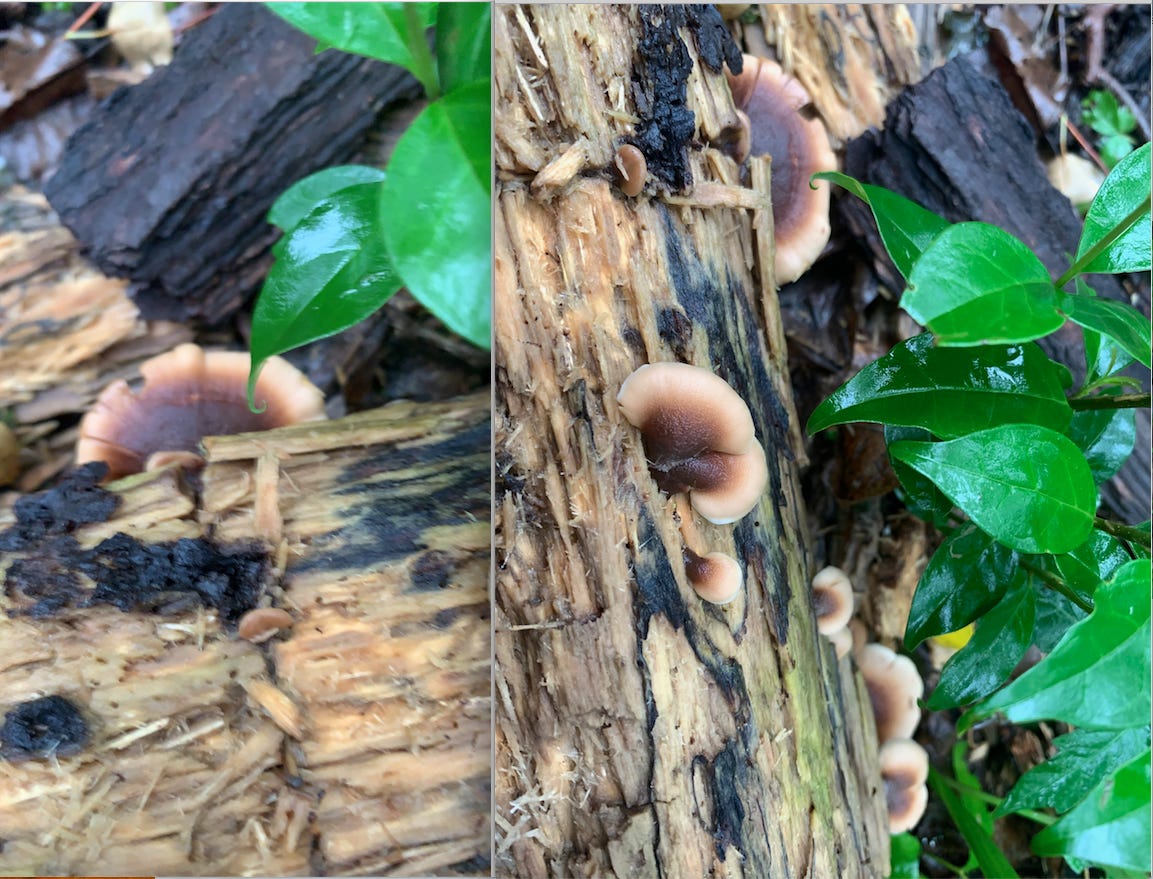
Bear Lentinus (Lentinellus ursinus): “What that wacky old Swede Elias Fries was thinking when he named the mushroom is beyond me. Nothing about Lentinellus ursinus strikes me as bear-like, except for the bear of a headache involved with identifying it. Like other species in the genus, Lentinellus ursinus grows on wood and features saw-toothed gills and a white spore print along with spores that feature amyloid* ornamentation. The species lacks a stem, which places it in the difficult-to-separate group of pleurotoid* Lentinellus species—several of which, for reasons unknown, are named after mammals. One begins to wonder whether the mycological founders were studying mushrooms or Aesop’s Fables.” (Michael Kuo at MushrooomExpert, who says it’s extremely hard to tell L. ursinus from L. vulpinus or L. castoreus, named after a fox and beaver respectively. So this might be any of those.)
*Kuo defines “amyloid ” as “a bluish-black color change when something is mounted for the microscope in an iodine-based reagent”; he also explains that “mushrooms with a ‘pleurotoid’ habit grow on wood, have gills, and typically form semicircular or kidney-shaped caps that are either directly attached to the wood or are attached by means of a rudimentary, lateral stem. They often grow in loose or dense clusters, forming shelf-like groups. However, many pleurotoid mushrooms can develop more or less central stems, especially when they grow on the upper surface of a log.”
*****
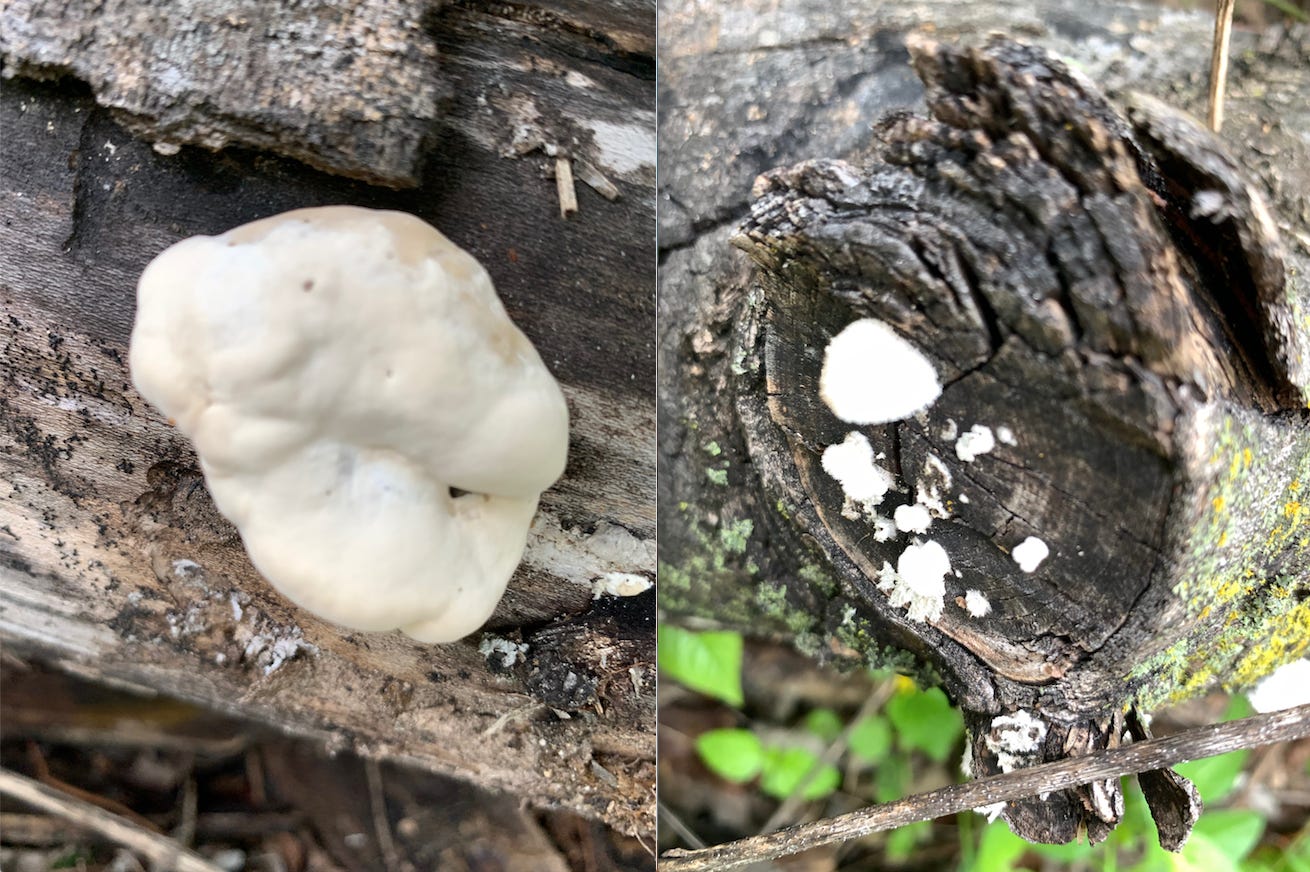
White Cheese Polypore (Tyromyces chioneus): “The ho-hum pinnacle of the polypore world, if you ask me. Its boring white cap and pore surface, combined with its soggy texture and lack of interesting microscopic details, are definitely not counterbalanced by the only ‘interesting’ thing about it: its slightly fragrant odor. Oh, sure, the world probably needs Tyromyces chioneus (it is a widespread and common decomposer of deadwood)--but that doesn't mean I have to get excited about it.” (Kuo, who can be pretty funny sometimes. He adds that it lives off dead “hardwoods, especially birch, causing a white rot,” not to mention that it’s “fairly widely distributed from the Great Plains to the Maritime provinces but apparently absent in the southeastern United States -- also reported in the Pacific Northwest and northern California.” Not sure where Texas fits into that geography, but that’s where I photographed mine.)
*********
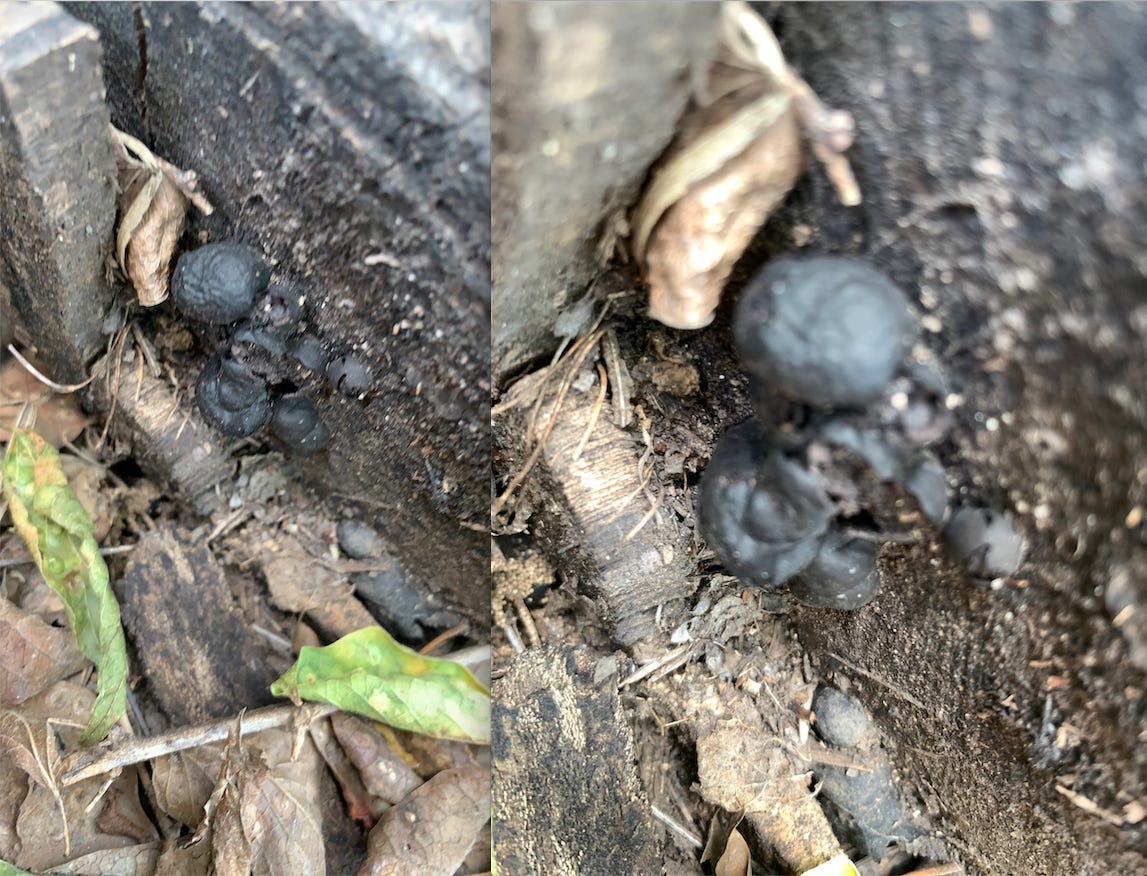
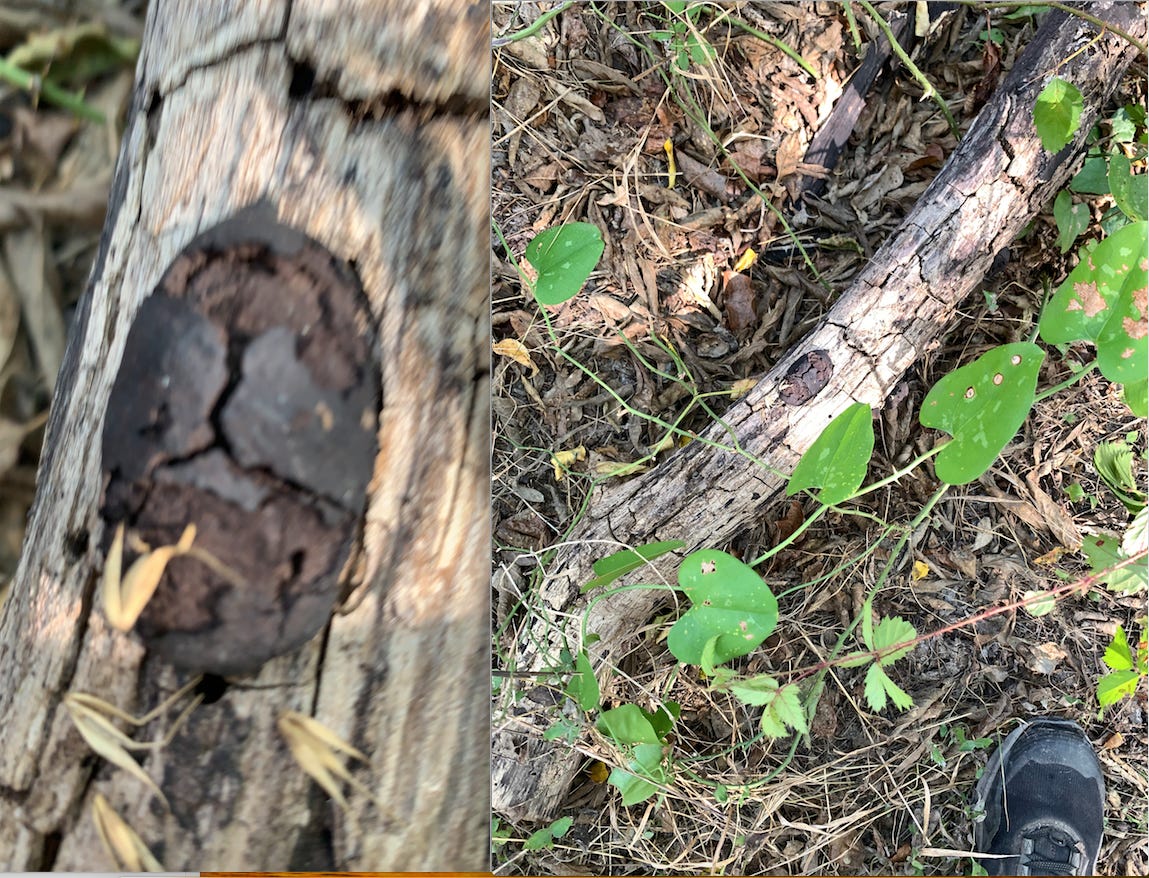
Dead Man’s Fingers (Xylaria polymorpha): “The fruiting body is white to pale tan when young and covered with ash-colored asexual spores. It gradually darkens as it matures to form the sexual stage. When inspected closely, the small embedded flasks (perithecia) can he seen like black dots on the surface….The surface is crustlike and minutely wrinkled. The fruiting bodies arise from rotting wood.” (Meltzers.) (My pictures look less “fingerlike” — “pointing,” the Meltzers say, “as if they are gnarled from arthritis” — than the ones I see pictured in books. More like dead man’s snails?)
********
Dog Vomit Slime Mold aka Scrambled Egg Slime aka Flowers of Tan (Fuligo septica): “Named for its resemblance to the mess your pooch leaves in the backyard…Although this slime mold isn't actually a fungus, it does look like one. It is an amoeba-like, single-celled organism that feeds on bacteria and rotting vegetation. There are over 900 species of slime mold and each one plays an important role as a decomposer and recycler of nutrients.” (U.S. Fish and Wildlife Service) “Thrives on decaying organic matter like mulch, rotting logs, and leaf litter. This slime mold is saprophytic, meaning it feeds on decomposing material, and often emerges in moist, shady areas during warm, wet conditions.” (The Spruce)