
Cracking Zeppelin's Coda

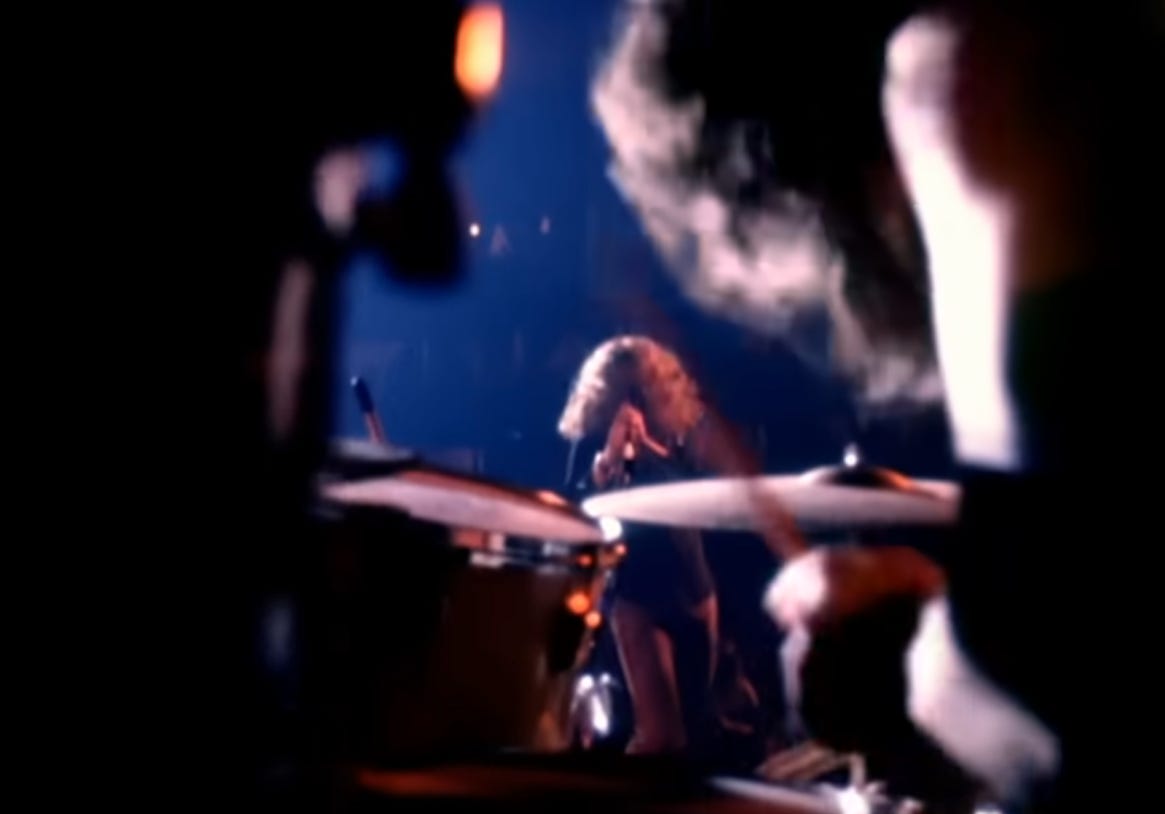
Coda, if you want to get merely factual, comprises eight odds and sods recorded in 1970, 1972, 1976, and 1978 (all even numbers!), almost none of which had shown up on any previous Led Zeppelin album; the only exception is a live 1970 soundcheck of Mississippi bluesman Willie Dixon’s “I Can’t Quit You Baby,” which song had appeared in a studio version on the band’s debut LP. On Coda, it’s the album’s most leaden pile of elephant plod. But hey, nobody else could plod like Zeppelin, right? And its lyrics still concern Robert Plant asking his buttercup why she builds him up just to let him down.
Coda came out in 1982, a couple years after John Bonham died, and he kills on the thing.
Three songs, including the first two, involve trains. Sort of. In fact, the first line of the first song, “We’re Gonna Groove,” has Plant’s baby “comin’ down the track.” As the long black mystery train carries her home, Bonham and John Paul Jones concoct a rhythm almost as deliriously funky as Spencer Davis Group’s “I’m A Man” or Deep Purple’s “Hush,” which is to say totally disco-worthy though disco didn’t exist yet (and it should be noted here that some early disco DJs, according to Tim Lawrence’s 2003 disco history Love Saves The Day, were known to work Zeppelin into their sets.) “We’re Gonna Groove” (reportedly recorded by Zep in 1970, though nit-picky fans have been known to quibble about such details) was written by soul man Ben E. King, but good luck finding it on a compilation by the guy. Jimmy Page’s guitar, allegedly overdubbed on a later date, builds to a monster howl. This band sure knew how to pack a lot of music into 2:37.
Track #2, also railroad-oriented and also from 1970, is “Poor Tom”, wherein Page strums nimble Celtic and/or Appalachian stuff over a big-shouldered, almost marching-band-like Bonham shuffle. Or maybe it’s Delta blues as art-rock—you decide. Its words, though, clearly make it a murder ballad: Plant (who eventually also honks some harmonica) wails about Tom, who’s been working on the railroad all the live-long day for decades while his spouse has been running around on him. So, as often happens in such numbers, he shoots her dead. At the end, Plant repeatedly instructs us to “keep a truckin’,” harking not only forward to the Grateful Dead’s 1971 “Truckin’” and Eddie Kendricks’ 1973 disco prototype “Keep On Truckin’,” but also back through R. Crumb’s 1968 Zap Comix “Keep On Truckin’” cartoon to North Carolina hokum bluesman Blind Boy Fuller’s 1937 “Truckin’ My Blues Away,” which is frequently credited with inventing said slogan.
For the third train song, you have to jump ahead to track #6, the 1978-recorded “Darlene,” a blatant boogie-woogie from Jones’s Moon Mullican-style piano all the way down to how Plant keeps telling us it’s a boogie-woogie. (And though I promise to drop the issue after this, readers should remember that, in 1978, the term “boogie” – as in “boogie oogie oogie” – was unarguably a disco word.) Anyway, the train part is, uh, how Plant consistently insists on pronouncing the name “Darlene” as “Double E,” which was of course the exact railroad line that lady’s man Warren Zevon had laid down his head on in “Poor Poor Pitiful Me” in 1976. Toward the end of “Darlene,” as the song evolves into more of a rockabilly hoedown, Plant also mentions his “pink carnation and pickup truck,” blatantly referencing Don McLean’s 1971 chart-topper “American Pie,” which in turn was quite possibly referencing Marty Robbins’s 1957 country crossover “A White Sport Coat (and a Pink Carnation)” (or crustacean, as Jimmy Buffett would say.)
Another blatant hillbilly reference on Coda is Plant repeatedly if incomprehensibly telling us he’s “walking the floor over you” (directly quoting Ernest Tubb’s 1941 honky-tonk progenitor of that title) in track #4, “Walter’s Walk”—a reported 1972 Houses of the Holy outtake which generally revolves around the idea that it had been a long time since Walter did the stroll. Also, Bonham’s magnificent rumble sure sounds a lot like the theme from the late ‘60s cartoon “George of the Jungle” in some parts. Except louder.
In fact, “Walter’s Walk” is probably the second heaviest track on the album, outdone in that competition only by Coda’s actual coda, “Wearing And Tearing” from 1978, which bangs its Burundi-metaled head through a tempo-shifting 5:28 of monstrous Page riffs and crazily shrieked proto-Judas Priest lyrics about painkillers. Ed Christman, veteran retail columnist at Billboard, tells me the track was initially “intended as a single in 1979 and was positioned as Zeppelin’s answer to punk rock, as if the band that recorded ‘Communication Breakdown’ needed to respond to punk criticism.” Good point!
“Wearing and Tearing,” interestingly, also has one weedy line (“just afoolin’ after school”) where Plant sounds like the White Stripes’ Jack White two decades early; likewise, in track #5 (“Ozone Baby,” also rec. 1978) he anticipates Billy Squier’s squealy singing style in the line “tired of you doin’ the things that you do.” But the true highlight of “Ozone Baby” (which oddly has nothing to do with fluorocarbon emissions) is probably Page’s lovely exploratory solo, two and a half minutes in. All in all, the three In Through the Out Door rejects on Coda, as many observers have pointed out, would have made that eccentric 1979 album punch much harder, and keep its feet on the ground more. (They would not necessarily have made it better. But that should not be held against them.)
So okay, that leaves the album’s only chronologically mis-ordered cut: Track #7, “Bonzo’s Montreux,” a fire set on the Lake Geneva shoreline in 1976 yet too often dismissed as a mere “drum solo.” To my ears, Bonham’s ultimate breaks and beats and Page’s squelchy electronic effects forecast everything from the mid ‘80s robot-jazz fusion of Herbie Hancock’s Sound-System and Ronald Shannon Jackson’s Decode Yourself to the late ‘90s big-beat rock-techno of the Chemical Brothers and Prodigy.
Yet more proof, as if any were needed, that Led Zeppelin were as ahead of their time as they were behind it.
Led Zeppelin, Voyageur Press, 2008