
Cluster FuGknus

For some reason, the more fungi I take pictures of in the woods and neighborhoods around these parts, the less I seem able to identify them. An article earlier this month in the New York Times science section might offer an explanation: “As many as 95 percent of the planet’s fungal species have yet to be described, according to a 2023 report from Royal Botanic Gardens.” On the other hand, maybe I’m just developing less confidence about my guesses? Or maybe I’m overwhelmed — with no posts about this unusual kingdom of living organisms for the past 3 1/2 months (since March 8 to be exact), and some of the dampest months of the year passing since then, the backlog just keeps piling up. To catch up may take take several posts.
If those posts ultimately come up short on verbal discussion, blame it on expedience and ignorance. But I’ll try anyway, starting with the post your reading, in which I’ll showcase some fungi I’ve photographed growing in clusters. Whether they’re actually related to each other or their similarities are superficial is above my mycological pay grade.
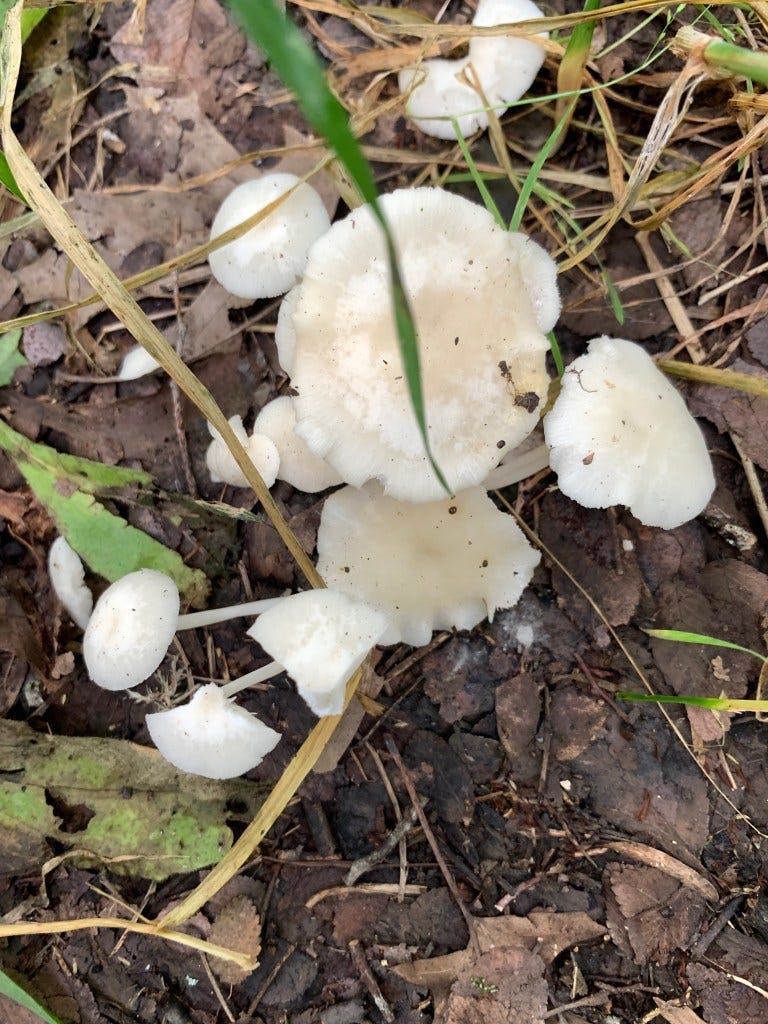
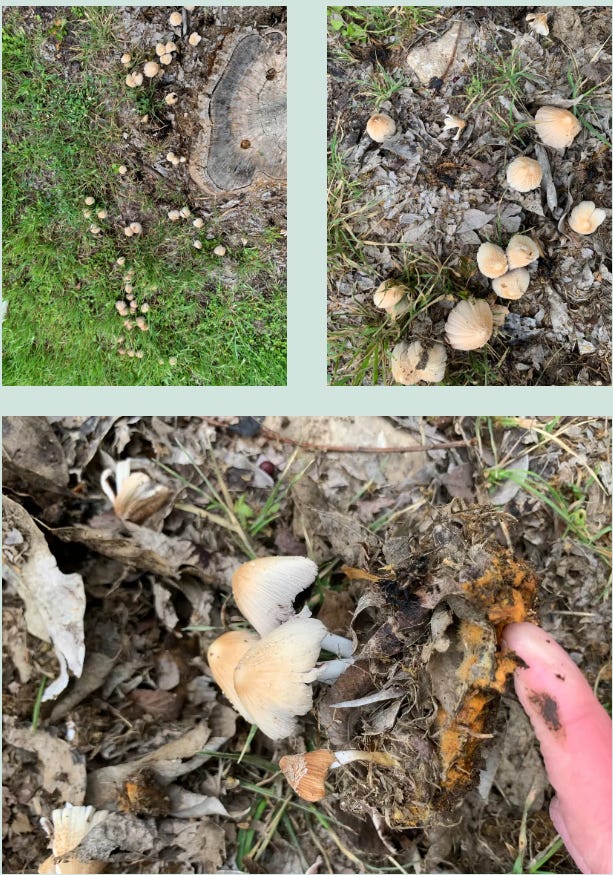
For instance, I have no idea what’s in the lovely photograph at the top of this page, so I’ll toss a dart a the wall and probably land way wide of the bullseye with Marasmius rotula (pinwheel mushrooms), or maybe their cousin Marasmius albuscorticis, desribed thusly by Susan and Van Metzler in Texas Mushrooms: A Field Guide: “The cup is white, thin fleshed, and nearly translucent”. As in previous posts, my primary print reference source besides the Metzler manual is Mushrooms: How to Identify and Gather Wild Mushrooms and Other Fungi by Thomas Læssøe. To be honest I probably need to acquire newer books. And to type better explanatory notes into my phone when I take pictures.
—
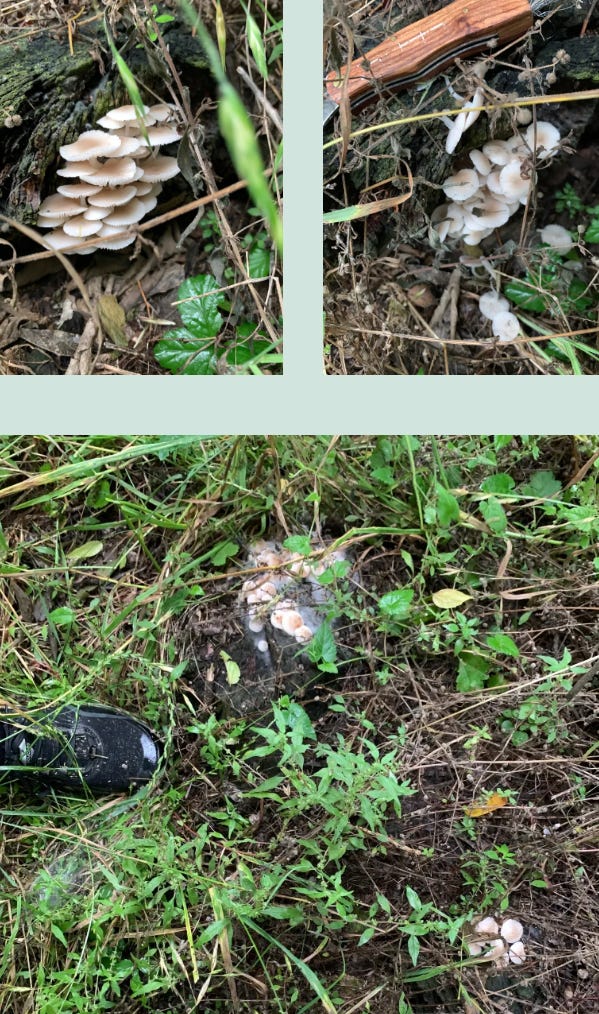
Fluffy little beige ‘shrooms, in miniature caves in a sort of hillside. Longshot species possibilty: Lentinus detonsus (“an off-centered stalk so it looks as if half the cap is missing….scattered to numerous along the trunk and branches, or occasionally living trees” — Metzler.)
—
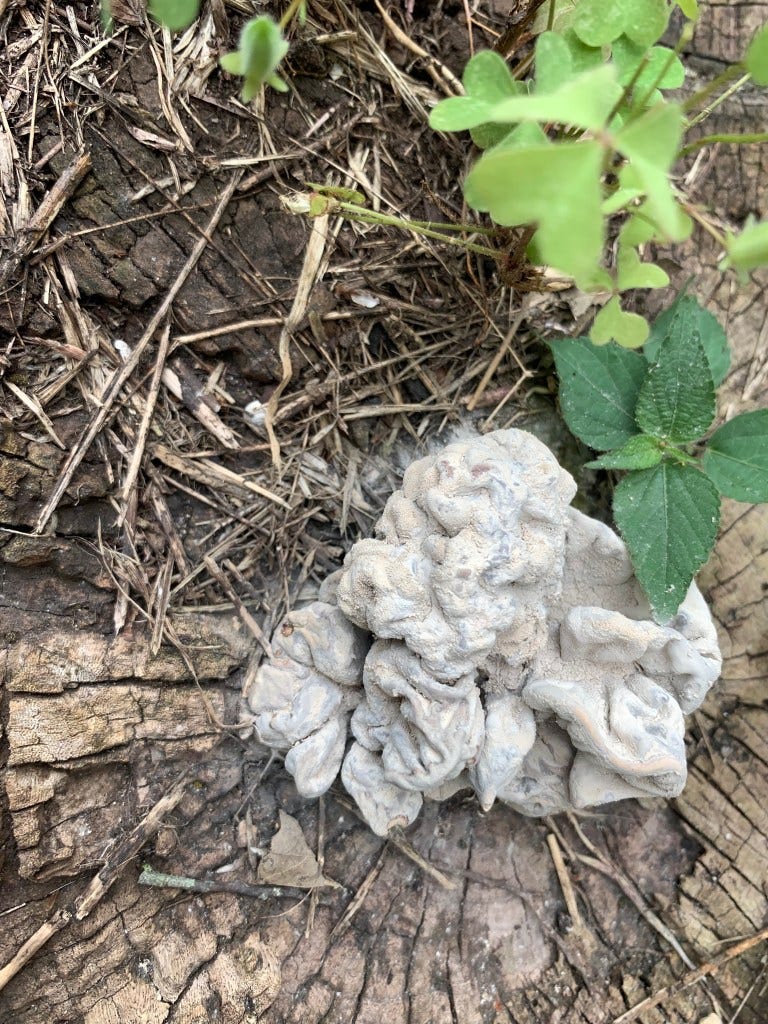
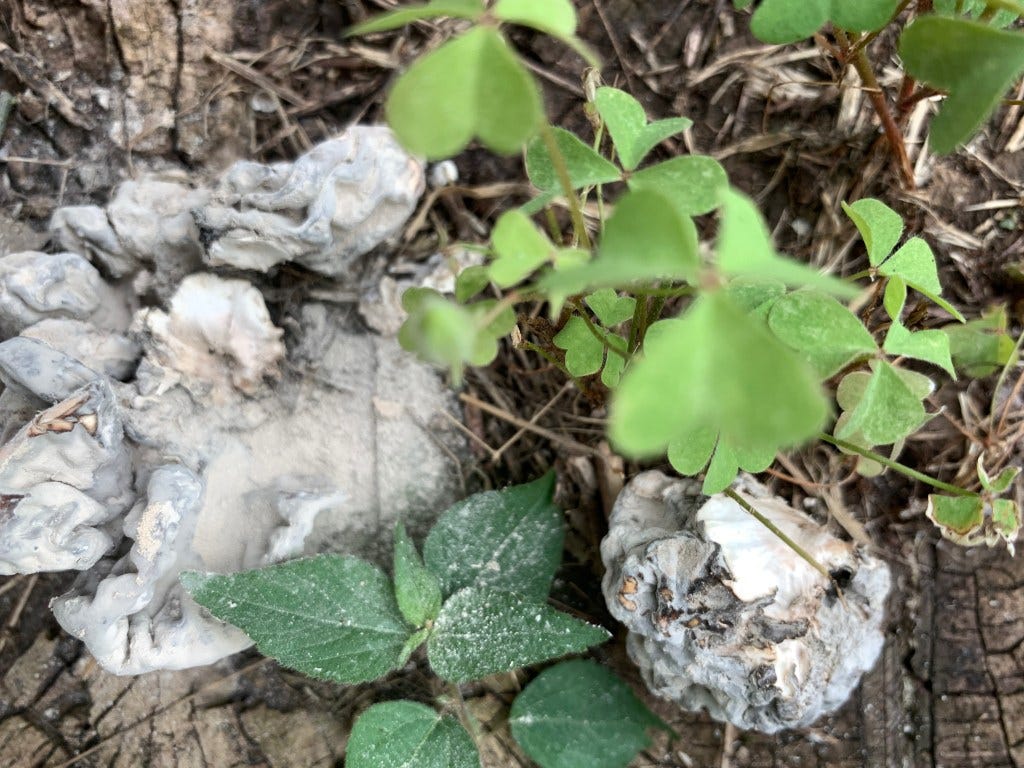
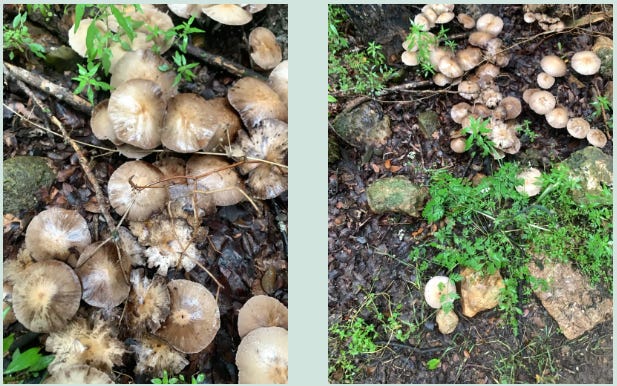
Chalky, greyish-white clumps. Not terribly appetizing, even if it does look kind of like cauliflower (and I do like cauliflower, at least if roasted in garlic and olive oil). Wild guesses: Sparassidaceae aka Cauliflower Fungus (“Huge, fleshy fruitbodies consisting of a multitude of lobes. All species are associated with dead wood” — Læssøe); Entoloma abortivum (“Aborted form occurs in clumps or groups of five or more specimens, united from a single base, often looking much like a smooth cauliflower” – Metzler); Meruliaceae (“Ill-defined family of skinlike and poroid fungi with fairly tough or gelatinous textures…The species occur on wood and produce a white rot” — Læssøe.)
—
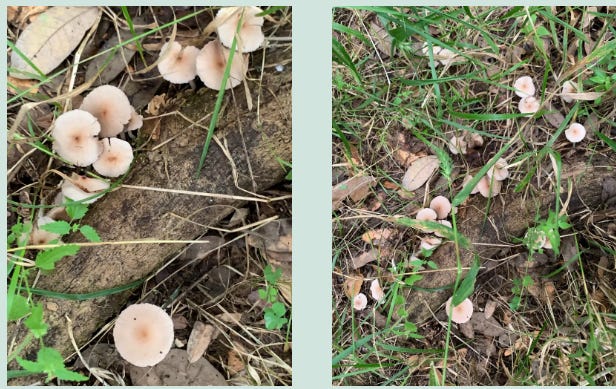
Tan center, whitening toward their edges. Delicate little umbrella-like things. Could be but probably isn’t: Coprinus plicatilis, seemingly an alias of Parasola plicatillis, the pleated inkcap (“Small mushrooms have a brown center that soon turns silvery gray, and radial lines form from the margin almost to the cap center. Thus they look like silvery gray parasols on the ground. There is almost no substance to the cap…Troops of this mushroom may number into the hundreds, springing up overnight and gone by noon on a dry, sunny day” — Metzler on Corpinus); Marasmiellus ramealis aka Twig Mummy-Cap (“This tiny agaric always grows in abundance along dead twigs….It tolerates fairly dry conditions” – Læssøe.) Is that orange stuff the mycelium?
—
I was originally going to conjecture that the previous ones might be Gymnopus confluens aka Tufted Tough-Shank (“Produces dense tufts of woodbodies. These tufts can spring from a fairy ring on thick leaf litter in woodland” – Læssøe), but I couldn’t come up with any guesses for these next ones so I’ll nominate that species here instead. It might conceivably fit for either. Or neither. Or both. Please consult an expert.
—
And maybe these are Lentinus detonsus, if the ones I guessed above weren’t? Picking names like these out of hat might be more reliable.
—
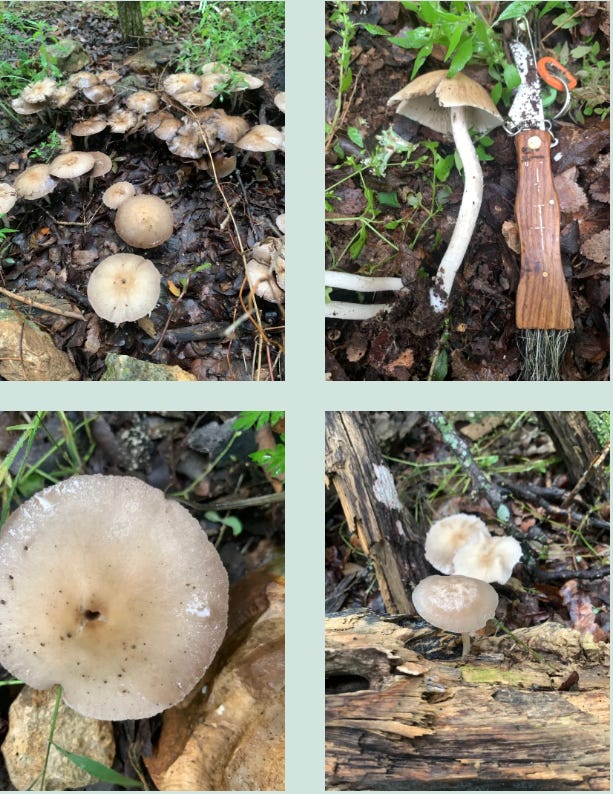
Amarillaria mellea aka Honey Mushroom (“Large yellowish fruitbodies and…the cap has a few pale scales and the slender stem is long and pointed. It inevitably grows in large clusters” – Læssøe)? Or maybe Oudesmansiella mucida aka Porcelain Fungus (“Slimy, ivory-white cap and prominent stem ring…on standing beech or fallen branches or trunks, more rarely it can also be found growing on oak” — Læssøe)? Well okay, maybe not the latter one, which was allegedly “absent in North America.” But that was in 2013 (American edition), and spores travel fast! If you can offer more educated theories, comment below.
Eliminated for Reasons of Space, 21 June 2024