
1978's Rock Rookies Lived Parallel Lives
What the Cars, Dire Straits, Van Halen and Toto have in common

So today’s question is, why did every big new rock band that put out a debut album in 1978 wind up having exactly the same career — or at least, more or less the same trajectory over their first several years?
At least four of 1978’s hottest rookie bands led off with what wound up being one of the two biggest albums of their career (a self-titled LP in all four cases), followed it with a sophomore set that sounded pretty much the same as their first but sold less, went downhill sales-wise often to the point that they disappeared from American album rock radio, then came back with a mega-blockbuster that wound up being the other biggest album of their career, which album even managed to cross them over to pop radio stations. Then they fell off again, forever.
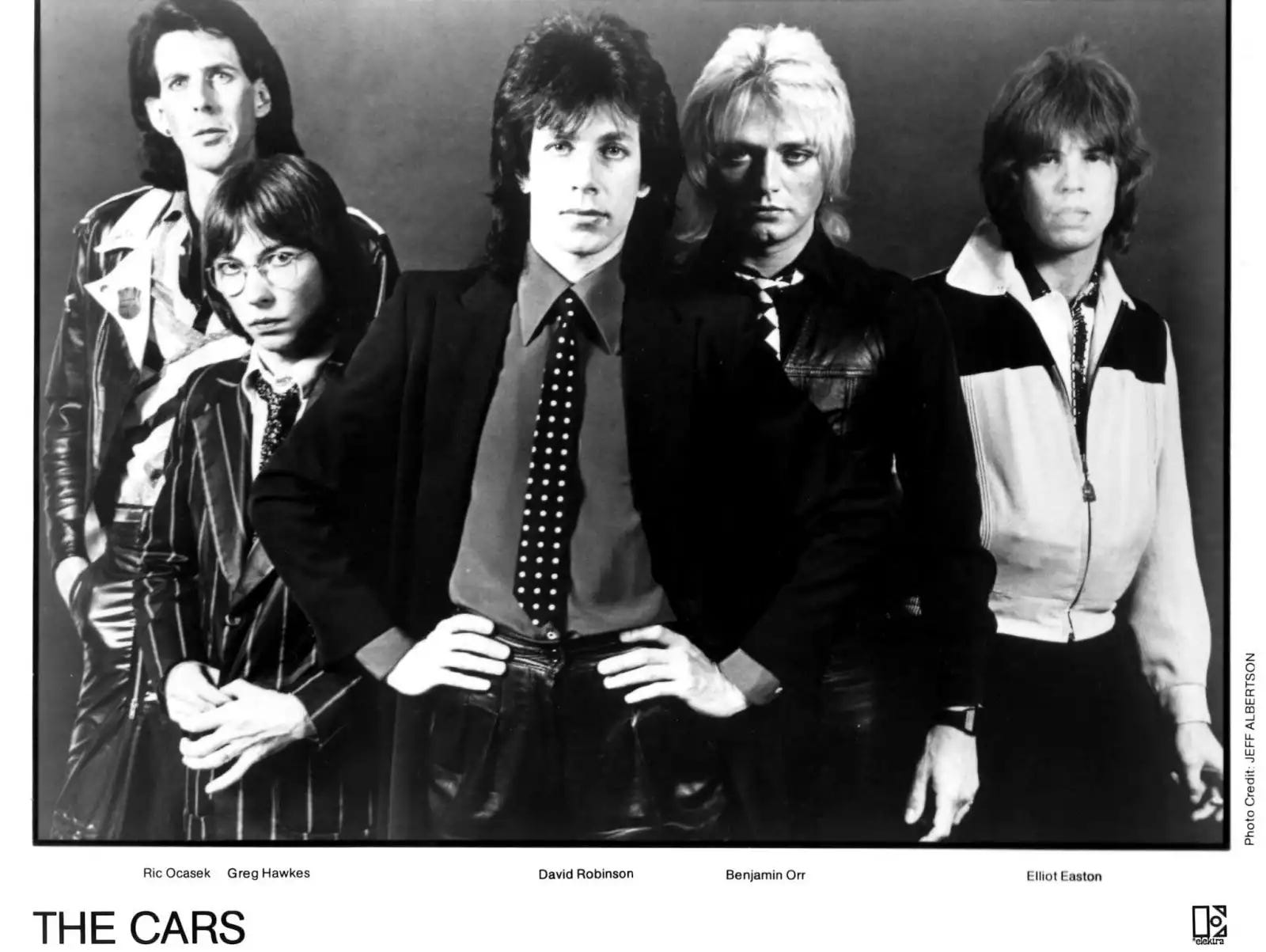
Exhibit #1 would be the Cars, shiny and new. According to their Wikipedia discography, here’s their early track record: The Cars 1978 sextuple platinum (which is to say it has sold six million copies in the United States, according to Recording Industry Association of America figures); Candy-O 1979 (which sounded a whole lot like the debut with maybe just a smidgen less of the Foreigner-style guitar muscle and Queeny multiplex harmony quotient that indie-raised rockophobes now complain about) quadruple platinum; Panorama 1980 (their artiest, spaciest, weirdest, most avant-garde album, which is to say I detect some Suicide and Kraut-rock in it) plain old regular platinum; Shake it Up 1981 (which nobody remembers) double platinum.
Then: 1984’s frustratingly non-weird (but quite good at it) Heartbeat City back up to quadruple platinum but this time with four top 20 pop singles (including two top 10s)! Sure seemed bigger than Candy-O to me — maybe even bigger than the debut, which no doubt sold plenty of its six million copies in historical retrospect, whereas long-tail sales of Heartbeat City were probably cut into by the sextuple platinum Greatest Hits LP that came out just a year later. Otherwise, after Heartbeat City, the Cars never came close again — 1987’s Door To Door mere gold (= 500,000 copies sold), and that’s pretty much it.
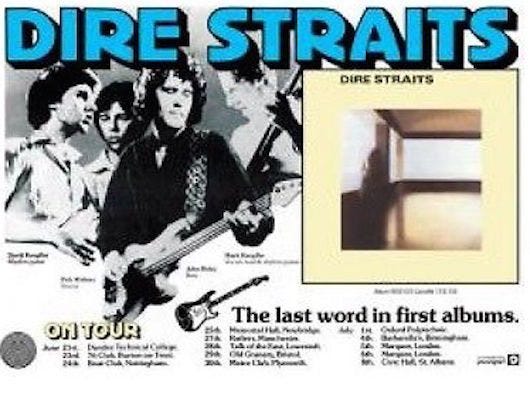
Now look at Dire Straits: 1978’s pub-rockish self-titled album double platinum; 1979’s near-Xerox Communique just gold; Greil Marcus fave Making Movies 1980 single platinum; largely forgotten Love Over Gold 1982 gold (kind of hilarious since it’s thus not “over gold” after all — at least in the U.S., as it was apparently a much bigger deal across the rest of the planet); then bam!, Brothers in Arms in 1985, which as of now has shifted nine million U.S. units — and which, shades of Heartbeat City, produced two top 10 pop singles and one more top 20.
There was also a four-song, 12-inch “dance” EP in 1983, before most people knew what EPs were (remember “Twisting by the Pool”? I recall hearing it quite a bit during my Army stint in Germany, whereas presumably Americans wondered what dancing to the “Eurobeat” could’ve meant) and a probably premature (and gold) live album in 1984. But post-1985, just like Cars post-1984, Dire Straits plummeted — in fact, they more or less broke up, though a 1991 reunion called On Every Street did go platinum, maybe for sentimental nostalgia reasons.
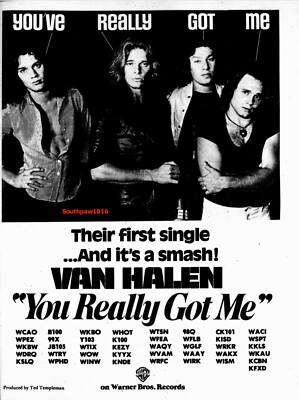
Van Halen put out an even bigger debut album in 1978 — The RIAA has designated it “diamond,” which means it’s sold at least 10 million U.S. copies over the years. Their next few went: Van Halen II 1979 (a faithful and arguably even improved copy of its predecessor that I’m surprised to learn sold only half as much) quintuple platinum; Women and Children First 1980 triple platinum; their artiest/most-out-there LP Fair Warning 1981 double platinum; phoned-in and lightweight (with hit Roy Orbison and Martha & the Vandellas covers etc.) Diver Down 1982 quadruple platinum; and then — wait for it — 1984 in 1984 bounced the band back to diamond, with three top 15 singles including their first and only #1 hit “Jump,” a keyboard-not-guitar-based classic that itself may well have been influenced by the Cars.
After which, for all intents and purposes, Van Halen broke up. Or at least they replaced life of the party David Lee Roth with humorless Sammy Hagar, with whom they had a few more big albums — in fact, 5150 from 1986 has sold six million copies in the U.S. — but they were never the same. Their next album with Roth, 2012’s A Different Kind of Truth, was fortunate even to go gold — in Canada! In the U.S, their Gary Cherone album sold more. And no matter which albums you count, they never mined diamonds again like they had in ’78 and ’84.
By the way, chart-watchers might note that the Cars’, Dire Straits’, and Van Halen’s debuts didn’t peak particularly high on the Billboard 200, at least compared to those bands’ next few albums. I don’t think this signifies anything, though, except that the bands were more or less unknown entities when those records came out. So their debut sales, as impressive as they are, were clearly more spread out over time. At least in Detroit, where I lived, all three got plenty of airplay — though Dire Straits, which came out late in the year, probably not until 1979.
Finally, there’s the strange case of also-inescapable-on-late-’70s-AOR Toto, who like the Cars were nominated for the Best New Artist trophy at the 1979 Grammy Awards ceremony (celebrating 1978 releases); other acts in the running were Chris Rea, Elvis Costello (whose debut had actually come out in 1977) and A Taste of Honey (who won on the heels of “Boogie Oogie Oogie,” which the disco-sucks crowd naturally viewed as a bit of a scandal at the time.) Dire Straits, whose first album came out toward the end of 1978, weren’t nominated until the 1980 awards (up against the Knack, Blues Brothers, Robin Williams whose debut comedy album didn’t even crack the Billboard 200, and the ultimate winner Rickie Lee Jones.)
Toto’s self-titled 1978 debut has sold two million copies over the years; their subsequent two, 1979’s underrated Hydra (easily their most adventurous and hardest rocking) and Turn Back from 1981 (a trivia quiz stumper if ever there was one) never got past gold. But then came 1982’s not very creatively titled Toto IV, quadruple platinum and counting thanks to three top 10 pop singles, including “Rosanna” which went #2 and “Africa” which went #1, both of which had the distinction of being semi-ironically covered by Weezer a few years back. Toto put out subsequent (merely) gold albums in 1984 and 1986, but — again — nothing anywhere near as popular as Toto or IV.
Toto never had much success in critics polls, but the other three bands had their moments. The Cars’ debut charted #9 in the Village Voice-run Pazz & Jop poll in 1978, the only time they ever placed on overall tally of what rock writers deem the best albums of any year. Dire Straits finished #18 with Making Movies in ’80 then (inexplicably I’d say) #20 with the jock-rocking Brothers in Arms in 1985, a year that also landed that album’s “Money For Nothing” as the poll’s #12 single.
Here’s Robert Christgau in his 1978 P&J essay, on music bizzers of the day: “Because it’s the nature of complacent cowards to hedge all bets–and because they want to prove they’re not, you know, square–they reassert their own putative attachment to ‘good’ rock and roll at the same time, thus easing the sales breakthrough of ‘twixt-[new] wave-and-[main] stream bands like the Cars and Cheap Trick. A similar snap-to by old fans (including radio people) who had previously been backsliding into resignation makes quick, surprising commercial successes of Dire Straits (42nd in Pazz & Jop despite late-year release) and George Thorogood and the Destroyers (51st despite a small press list), spearheading a minor white-r&b revival.” (He doesn’t say whether post-minstrel-show schticksters the Blues Brothers, whose late November release Briefcase Full of Blues wound up going #1 and double platinum, received any votes. Let’s hope not.)
Van Halen were no kind of critics band until 1984, when their album of the same name placed #25 and “Jump” managed fifth place in singles balloting. Maybe more indicative, three of these bands also did well in Pazz & Jop’s mid ’80s music video polls: the Cars’ “You Might Think” #4 in 1984; Van Halen’s “Hot For Teacher” #3 and “Jump” #5 that same year; Dire Straits’ “Money For Nothing” #2 in 1985. So as these mid-career album rock outfits were polishing their Contemporary Hits Radio (mid ’80s biz-speak for “Top 40”) skills, they were clearly also honing their MTV skills — or at least putting themselves at the mercy of directors who’d help them. Otherwise, was there some development in music or the industry that made all their trajectories run so parallel?
Something to do with the advent of cable television, or new wave rock discos, or portable cassette players? Your guess is as good as mine. I will say this: When MTV came on the air in 1981, most bands who had clips ready were young, photogenic and disproportionately British. I guess it’s conceivable those early video upstarts left radio stalwarts like the Cars, Dire Straits, Van Halen and Toto (not to mention more prehistoric relics like ZZ Top and Genesis) behind — forcing the older guys to take notes, learn new tricks, and eventually catch back up.
Two post-scripts: For whatever it’s worth, Prince (also conceivably inspired by the Cars) put out his first album in 1978 as well, and his sixth and biggest was 1984’s Purple Rain; he doesn’t really fit into this equation since his debut sold next to zilch, but he probably deserves an asterisk since his second (which was self-titled!) went platinum via a big radio single, and then nobody but rock critics and Detroit DJ Electrifying Mojo cared about his third. The Police’s debut, meanwhile, came out in November 1978 in the UK and February 1979 in the U.S. (Internet sources suggest otherwise, but I’m trusting my memory and the meticulously researched Volume 1982/83: International Discography of the New Wave, from back when the dates were much more fresh), but that band was pretty much platinum from the start so never mind — they did, though, peak commercially with their fifth album, 1983’s Synchronicity, which sold eight million copies. And for them, as for so many of their contemporaries, that was all she wrote.
Eliminated for Reasons of Space, 25 March 2024
Great piece - when discussing sales figures for these albums released prior to the big market switch to CDs, and to fan bases that were largely in the sweet spot market for that format switch, I'm always curious to know how many sales are attributable to fans who were upgrading the format of an album they already owned (from LP or cassette to CD). Something I also think gets overlooked when talking about Van Halen is just *how massive* their album sales numbers were - they're one of a very select group of bands that managed to pull off *two* diamond albums.